
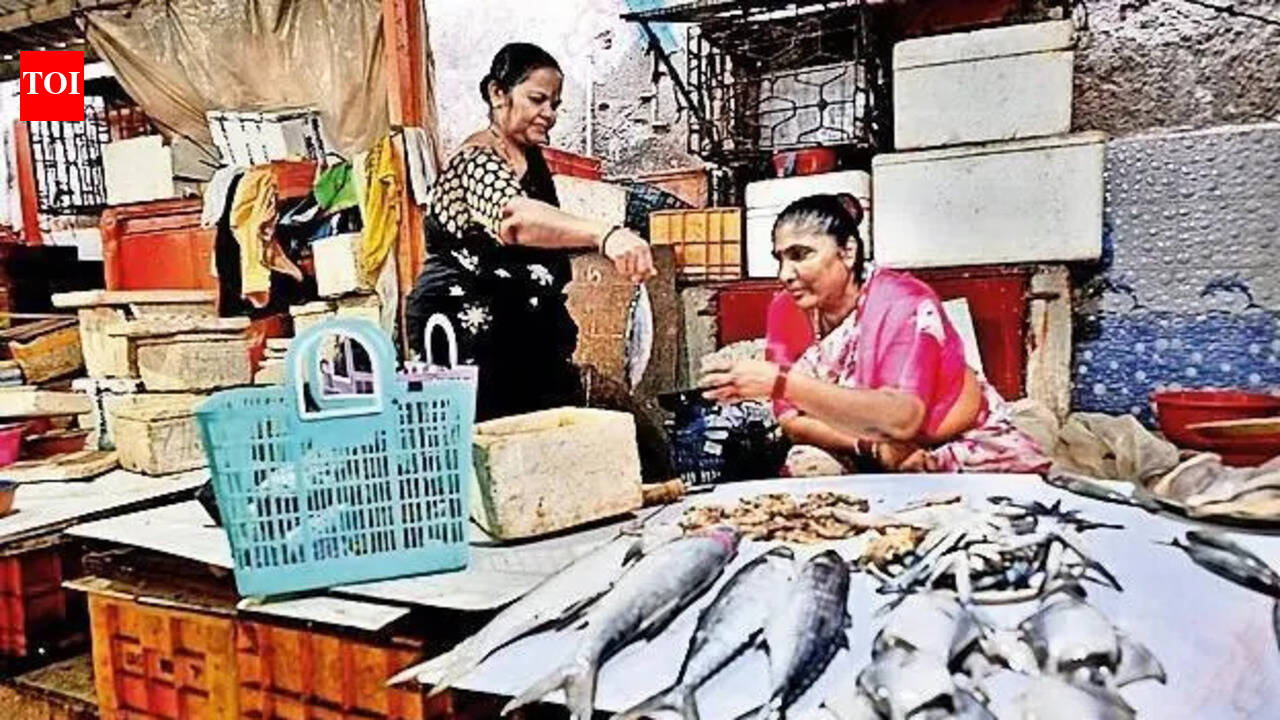
It’s a Thursday morning in late April, and three directors and several shareholders of a seafood company are gathered around a conference table, absorbed in a presentation on food packaging.“When a package is properly sealed, it assures the buyer of the product’s quality and builds consumer confidence,” says the instructor at the Indian Institute of Packaging (IIP), in Marathi. “Good packaging adds value to a product; it can even fetch a higher price.”As the directors nod, the silver tinsel in the pechak-che gajre in their hair and the gold naths at their noses gleam in the light. The Koli women have never attended a workshop on packaging before. Nor have they ever worked for a company—let alone run one. Yet they are directors of Daryavardi Producer Company Limited (DPCL), Mumbai’s first fish farmer producer organisation: a community-owned enterprise led entirely by Koli women that aims to transform the community’s centuries-old fish-vending trade from a cottage industry into a corporate venture.April marked three years since the company’s formation.“We didn’t realise that packaging affects shelf life; we always sold fish in polythene bags,” says Pratibha Patil, a director from Juhu Koliwada. “We’ve now learnt that packaging that is leakproof and attractive is not only more hygienic but can also help us sell more.”For over 600 years, Koli women have plied their trade as they learnt it: moving in a straight line from landing centres and wholesale markets to independent sales counters. Even as markets evolved and competition cut into profits, their model remained largely unchanged. But new currents are now coursing through the community, altering the way its women do business.And better packaging is only part of the shift. The larger picture includes streamlined operations, centralised logistics, product development, digital payments, soft-skills training, branding and marketing—all the functions of a modern business reshaping Koli commerce.“We decided to follow the Amul model, bringing together Koli women to collectively produce and market fish and fish-based products. And because we wanted complete autonomy, we chose to run the enterprise not as a cooperative, but as a company,” says Ujjwala Patil, a community leader who founded the fishers’ rights organisation Daryavardi Mahila Sangh in 2018—the company’s ideological forerunner. “What Amul did for the White Revolution, DPCL will do for the Blue Economy.“The company is an agglomeration of more than 50 self-help groups anchored in koliwadas across the city, each carrying out specialised work—from fish procurement and processing to masala-making—that supports the larger business. Co-piloting the community on this venture is the nonprofit Vrutti, which specialises in building community enterprises and has helped guide the fishers from an informal, fragmented economy to a more formal and unified one.“We formed the company in April 2023 with a capital of Rs 1 lakh, with each of the ten Koli women directors investing Rs 10,000,” says company CEO Lalit Jadhav, the only man brought on board for his experience in corporate and financial planning and in managing self-help groups at NABARD. The directors’ seed money was supplemented with share capital raised through women fish vendors.As shareholders, the women would gain access to professional training, resources, infrastructure and markets through a network of government bodies including the Central Institute of Fisheries Education (CIFE), IIP and the BMC, as well as nonprofits and private-sector partners. More importantly, they would have a consolidated voice—and, with it, greater commercial clout.“Initially, however, it was difficult to organise the women and get them to agree to work with the company for both collective and individual success,” Jadhav admits. But Vrutti’s persistence paid off. As word spread of a community-owned enterprise rebuilding the Koli brand, the numbers swelled.Today, DPCL has more than 1,000 shareholders—women who have collectivised, organised and corporatised to secure their livelihoods in a land- and seascape changing faster than a fisherwoman can call out “mavri”.Soon enough, they may not need to.DPCL’s executives now receive orders on WhatsApp and Google Forms, which they process, package and dispatch through delivery platforms across Mumbai and Pune.Shareholders engage with the company in different ways. Some work at DPCL’s manufacturing units, earning Rs 500-600 daily for 5-6 hours of work producing masalas, rotis, pickles and ready-to-eat snacks such as fish chaklis. Others clean and cut fresh fish for the company’s retail platform, which delivers to customers across Mumbai and Pune. Many continue to sell independently, sourcing fish from DPCL’s wholesale trading desk at Crawford Market at competitive rates. Some do both—working for the company while continuing to run their own businesses.“The women are free to choose an arrangement that works for them—the work hours are self-distributed to accommodate individual needs, and the centres are managed entirely by them,” says Sonia Garcha, project lead at Vrutti.They’re also diversifying—setting up Koli-themed buffets at private parties and stalls at food festivals, running live food counters at municipal seafood plazas, and selling online. A community kitchen has been set up, a cloud kitchen is in the works, and export markets are being explored.Last year, DPCL was inducted into the Agri-Business Incubation Centre, an initiative of CIFE to nurture fisheries startups. An MoU between CIFE and IIP is now in the works to develop sustainable packaging solutions for the company.“The first phase involved incubating the company; we’ve now moved into accelerator mode, which introduces an entirely new aspect of business to the Koli women—branding and marketing,” says Garcha.Fifteen months ago, the Pune-based brand consultancy Seagull Advertising began working with the company to build a brand, drawing on the Kolis’ rich cultural heritage and fishing legacy to turn inherited knowledge into market value.“We are building a consumer-facing brand that people will immediately associate with the company,” says Sameer Desai, founder and managing director of Seagull, which designed a logo and merchandise for the women, including vendor umbrellas, aprons, caps and uniforms. “It was a participative, consultative process in which the women weighed in on every decision.”DPCL’s story was even documented in a brand book launched last month that Seagull believes can serve as a handbook for other community enterprises on a similar journey.The Koli women, meanwhile, are proud of their company—for both its commercial success, having generated revenue of Rs 20 lakh in the last quarter of 2026, and the cultural renewal it has sparked. “There was a time when Koli women held great sway in the city; no one messed with us,” says Archana Koli, a shareholder and fish vendor from Worli. “Now, people will respect our name again.”