
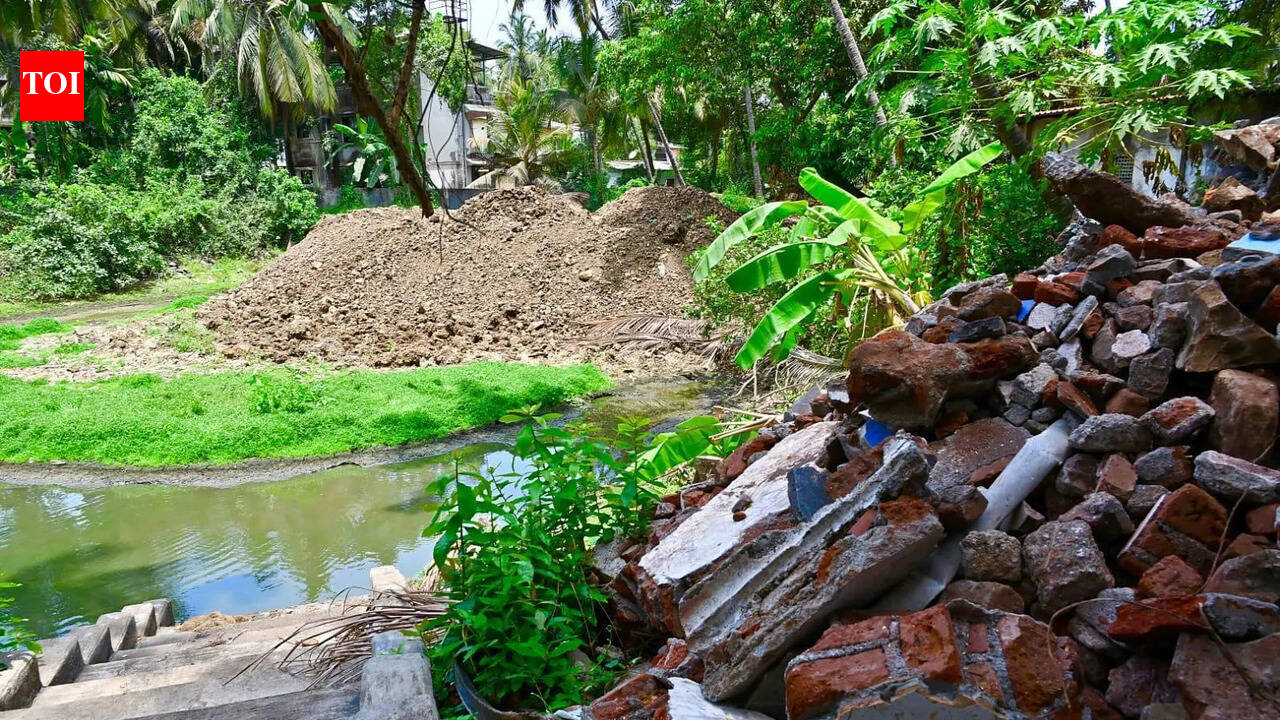
On a blindingly hot morning in Vasai, Ranjeet Vartak leads us down a rutted rack in Bhuigaon Village and gestures towards a scene that could be mistaken for a trick of the light—an informal housing settlement sitting solidly on what ought to have been a 3,067 sq m body of water.Vartak then points to a map in the CIDCO Development Plan Ariel Survey for Vasai Virar (1998) Sub-Region, where the pond continues to exist. “Until a few years ago, this illegally reclaimed pond on revenue land was a public waterbody,” he says, “But those asbestos sheds that now occupy it are privately owned and rented out to migrant workers.”In Jasodi Village, a different dirt track leads to another housing project that has planted its feet in an erstwhile pond — only this one comprises upscale villas soon to go on the market. “In this case, the pond was owned by a family who sold it to a builder,” he says.Vartak, a tour coordinator with a prominent travel company, is leading a different kind of tour today — one that exposes the systematic decimation of Vasai’s traditional water system: its bavkhals.Bavkhals are centuries-old private and communal ponds—some as large as an acre— scattered across Vasai taluka in Palghar district, a network numbering at least 800. An ongoing survey by the Aga Khan Agency for Habitat, combining GIS data and site visits, has mapped 569 bavkhals in west Vasai alone.Fed by rainwater and run-off, these waterbodies replenish local aquifers and are in turn sustained by them, forming an integral part of the region’s water supply — particularly in rural areas where civic pipelines, where they exist, run dry.Vasai’s villages—which spearheaded the Pani Andolan of the 1980s and 1990s against the commercial extraction of water by tankers serving the region’s growing construction industry and urban water demand—are mobilising once again. This time, however, the struggle is not over the extraction of water but the disappearance of the waterbodies themselves.“Land in Vasai’s villages is selling for Rs 30–50 lakh per guntha. A bavkhal is typically 2 to 35 gunthas,” says Vartak. “Do the math.”As land has come to be valued more highly than water, bavkhals have been quietly reclaimed and built over, increasing the region’s vulnerability to water scarcity, degrading groundwater quality, disrupting local ecosystems and heightening the risk of flooding.“We’ve lost more than 50 bavkhals in the past six or seven years to landfilling by landowners and builders,” says a local activist. “In the last five months alone, eight bavkhals have been filled.“For several years, Vartak has been gathering photo and video evidence of landfilling. These, along with satellite imagery documenting the slow eclipse of these waterbodies, are the proof he has presented to civic officials, from the tehsildar to the Collector. “I’ve filed 14 complaints from 2019 to 2026,“ he says. Not a single person has been penalised; not a single bavkhal restored.His complaints enumerate a raft of legal and statutory violations allegedly committed by those involved, ranging from breaches of the Environment Protection Act, 1986, and the Water (Prevention and Control of Pollution) Act, 1974, to offences under several provisions of the Indian Penal Code, including obstruction of public water supply and criminal conspiracy.They also invoke the Public Trust Doctrine — which requires that natural resources be protected for the public’s benefit — as well as principles laid down in Supreme Court judgments such as Mirza Abid Beg vs. State of U.P. & Others, which holds that illegally filled ponds must be restored to their original condition.On paper, no waterbody in India, whether public or private, can be reclaimed for infrastructure without first passing through a series of stringent legal and regulatory checkpoints. In practice, it is easily done — especially when the reclamation happens out of sight, or as is common in Vasai, behind a brick wall or a construction fence.The remoteness of these waterbodies compounds the problem. Hidden within hamlets and scattered across private and communal land, they are difficult to monitor. Their small size and dense tree cover also make them challenging to map, often rendering them invisible to both satellites and the state.But not to local communities, who, concerned about their worsening water problems, are increasingly smoking out encroachers.In Merces, it was the procession of dump trucks to the privately owned Chopra Farm in Rewad Wadi that set off alarm bells. Learning that the bavkhal within was being filled for the eventual sale of housing plots, around 50 villagers — along with Vartak — reported the matter to the tahsildar and filed a panchnama. But the reclamation continues; as of May 19, the pond was more than half filled with soil.“If we fill our reservoirs, how will groundwater recharge?” demands Colin D’Cruz, a resident of Bendale Wadi. “Merces has no municipal water supply; we rely entirely on borewells and dug wells, and with each passing summer, both the water level and quality have been declining. The level in our borewell has dropped by five feet in the past five years, while salinity and Total Dissolved Solids have risen.” A water sample from his borewell measured a TDS of 900-1,300 ppm; the WHO’s recommended standard is 300–600 ppm. (Some wells in Bhuigaon have recorded TDS levels as high as 5,000 ppm.)Every household in Merces now has a water purifier for drinking and cooking, but sediment filters must be replaced every four to six months, says D’Cruz. “Some families have even installed expensive water softeners to prevent corrosion and limescale buildup in appliances like washing machines.”Activists allege that several bavkhal owners have had their ponds reclassified in revenue records as pot kharaba, a category for non-cultivable land, or converted to non-agricultural status to facilitate development.This practice, however, may soon grind to a halt.According to Prithviraj B.P., the new commissioner of Vasai-Virar City Municipal Corporation, plans are afoot to include the bavkhals in the new Development Plan. “Many of these bavkhals were identified as no-development zones in the previous DP. As we prepare the new DP, we will cross-check revenue records and, wherever a bavkhal is recorded, make every effort to include it in the plan.”He added that a ground survey was also being conducted by the Tahsildar and the Sub-divisional Magistrate to map the exact position of these waterbodies.“Once it’s in the plan, it will be designated as a No-Development Zone,” he continued, “and if a construction comes up on it, it will be treated as illegal. Bavkhals are a unique feature of Vasai that must be protected and preserved well into the future.”