

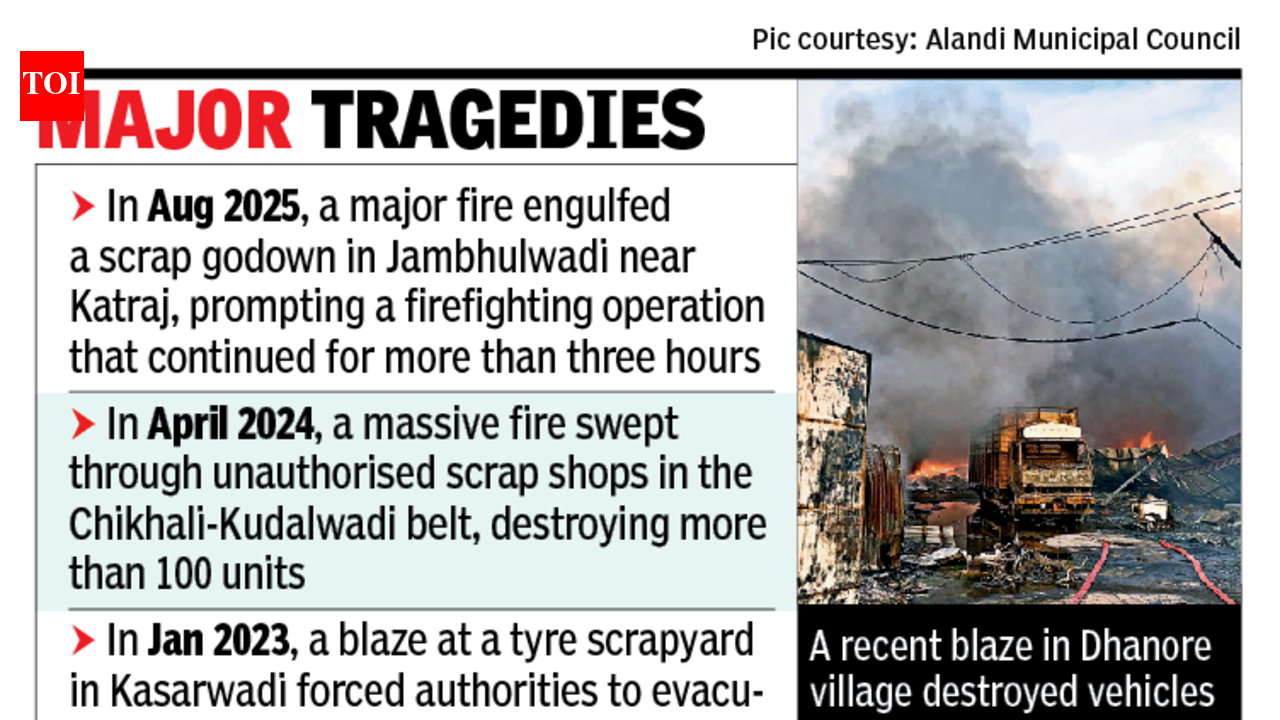
Pune: Hundreds of privately operated scrap yards spread across industrial pockets and villages surrounding Maharashtra Industrial Development Corporation (MIDC) areas in Pune district are emerging as a major public safety hazard, with recurring fire incidents exposing glaring gaps in regulation, fire safety compliance and official oversight.Operating on privately owned plots, these scrap yards have mushroomed over the years around industrial belts such as Chakan, Bhosari, Talegaon, Ranjangaon and Solu-Markal. While these businesses generate substantial rental income for landowners and provide employment to scrap collectors, authorities admitted there is little accountability about the materials stored, processed or discarded at these facilities.A fire that broke out at a scrap yard in Dhanore village near the Solu-Markal MIDC area on June 2 once again brought the issue into sharp focus. Two vehicles, including a tempo, were destroyed, while scrap material worth nearly Rs 50 lakh was reduced to ashes. Firefighters from the Pimpri Chinchwad Municipal Corporation battled the blaze for more than three hours before bringing it under control.“The most dangerous aspect of scrap-yard fires is the unpredictability of the material stored there. We often have no idea what is present inside these heaps of scrap. In this incident, three LPG cylinders were found at the site, significantly increasing the intensity of the fire. Such situations are extremely risky for firefighters,” a senior fire brigade officer told TOI.MIDC distanced itself from the operation of such units.“We have not allotted any MIDC plot for scrap-yard activities anywhere in the district. Our jurisdiction is confined to MIDC-owned land. However, such establishments can certainly pose safety threats to nearby industries. If complaints are received, we will raise the issue with the district administration,” said Kalidas Bhandekar, chief engineer of MIDC.The danger extends far beyond property losses. Many scrap yards employ migrant labourers and scrap collectors who often reside in makeshift sheds erected within the premises.“Cooking arrangements, LPG cylinders, temporary electrical connections and large stockpiles of plastic, rubber, tyres, chemicals and industrial waste create conditions ripe for a major disaster,” a fire brigade official said on condition of anonymity.Residents living near these facilities feared that a major blaze could quickly spread to nearby houses, warehouses, fuel depots and industrial units. Fire officials said narrow approach roads, lack of water sources and the absence of mandatory firefighting equipment further complicated emergency response efforts.“The cascading effect of these incidents could result in a major tragedy. No authority has ever paid adequate attention to this business, nor is it properly regulated. It is a serious concern for industrial units because these shops operate in proximity to them. If anything goes wrong, industries in the vicinity could also suffer. Therefore, authorities need to regulate these establishments to avert future tragedies,” said a senior office-bearer of the Chakan Industrial Federation.“With industrial expansion continuing across Pune district, safety experts warn that unless authorities undertake a comprehensive survey, licensing drive and enforcement campaign against unauthorised scrap operations, the next fire could have consequences far more devastating than property damage alone,” said Mahesh Bhiware, a Chakan-based lawyer and activist.TOI’s calls to district collector Jitendra Dudi went unanswered.