
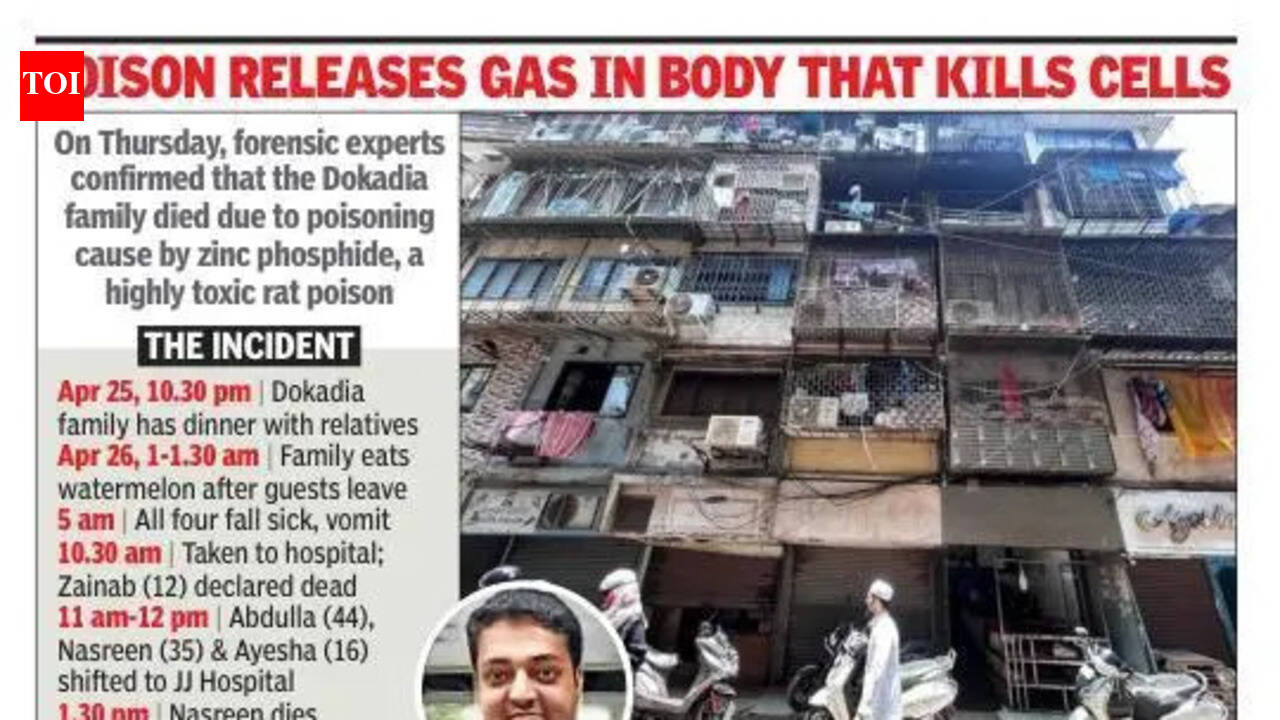
Mumbai: Eleven days and 54 tests later, forensic laboratories in Kalina have found that rat poison in the watermelon killed four members of the Dokadia family in Bhendi Bazaar’s Pydhonie area.Senior forensic officials from state forensic labs (FSL) said that zinc phosphide (rat poison) was found within the fruit as well as the viscera (internal organs). This includes liver and kidney spleen samples as well as stomach bile and abdominal bile.“There was no indication of external contamination on the fruit. The poison was on the inside. It is unlikely to have entered the fruit through an injection,” FSL official said.Officials said how this substance ended up inside the fruit will now form a central part of police investigations.J J Marg police confirmed this report had reached them. “The report will be studied in depth. In consultation with forensic doctors, further investigation will be continued,” said DCP Dr Pravin Mundhe.Police sources said they will probe all angles to ascertain how their food (watermelon) was poisoned: whether it happened at the vendor’s end or if someone else is involved.They are yet to decide if to treat this case as homicidal, accidental or suicidal. There was no indication of rat poison in the Dokadia house, police said.On Wednesday, TOI reported that this case required FSL more time to solve than usual. While toxins are typically detected within the first 10 to 20 rounds of testing, the Dokadia case was a tough one. “The family had vomited out a large portion of the toxin, which is why it required 54 rounds of testing to identify the trace amounts remaining,” the forensic official said.The official further noted that the ingestion of zinc phosphide triggers the creation of phosphine gas within the body. When this gas seeps into the lungs, it causes a rapid collapse in oxygen levels. “This is why the youngest child passed away first. Her body could not sustain the poison. The timeframe of the reaction depends on an individual’s body mass and health. Death in zinc phosphide cases is almost certain once the gas is released within the body,” the official added.The four who died on the second floor of Mughal Building in Bhendi Bazaar’s Pydhonie area have been identified as: Abdullah Dokadia (44), who owned a mobile phone accessories shop in Andheri; his wife Nasreen (35); and daughters Ayesha (16) and Zainab (12).The watermelon, which only these four ate on Sunday (April 26) at 1:30 am, following a Saturday night family feast of chicken pulao with five other relatives, led to their deaths. The forensic result for the pulao and all the other edible items was negative.Hours after consumption, they all began experiencing discomfort, vomiting, and diarrhea. They were rushed to hospitals where they died one after the other. Zainab was the first to die around 10 am, while Abdullah was the last one to die around 10 pm.Dr Rukmani Krishnamurthy, former FSL director, said zinc phosphide is highly toxic and the deadly dose is very low. “It is also easily available. It could either be an intentional ingestion or it could be that somebody put it inside.”She added that in such cases, doctors could have saved them had they reached the hospital earlier. At state-run J J Hospital in Byculla, doctors had followed the protocol: stomach wash and the strongest of medicines, but all failed.Dr Hemalata Arora, internal medicine doctor at Nanavati Hospital, said stomach washes work if you are washing within one hour after consumption. “Once the stomach is empty, there is nothing to wash.”She said the timeline of the symptoms depends on the quantity of the poison consumed. “As four to five hours had passed after consumption, the dosage was likely very low, because a high dose would have shown symptoms much faster,” said Dr Arora.Meanwhile, there were speculations that the family was in poor financial situation but police had earlier called it baseless.They also went through the family’s medical history. “We had found ayurvedic and unani medicines, these are still under investigation,” said a JJ Marg police station officer.He added that it was a happy family, as far as the investigation so far is concerned.