

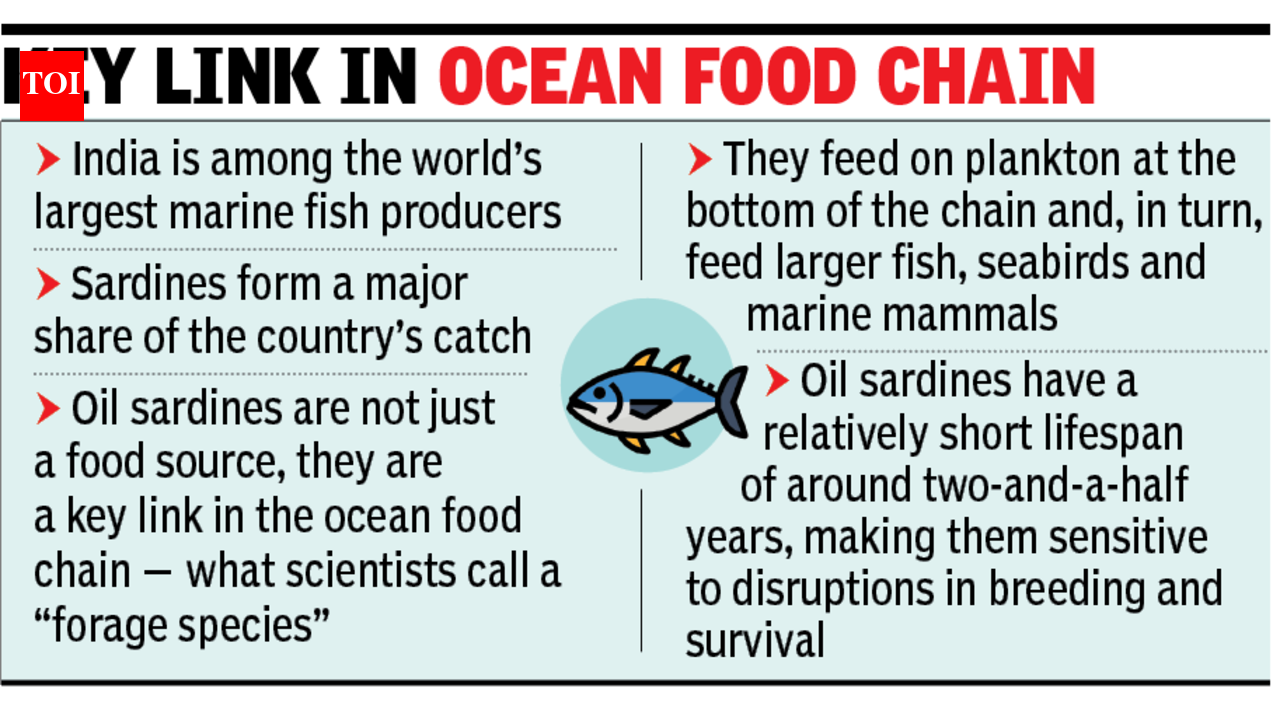
Pune: A steep rise in fishing pressure, coupled with climate-related changes, could seriously affect the sardine count along the country’s southwest coast.Researchers from the Indian Institute of Tropical Meteorology (IITM) and National Centre for Ocean Information Services (INCOIS) warned thousands of coastal households dependent on India’s sardine catch about this after studying over five decades of fish catch data from India’s west coast. The team found that large-scale weather changes affected winds and ocean conditions that determine food availability and breeding conditions for sardines.India is among the world’s largest marine fish producers. Sardines form a major share of the country’s catch.The researchers said moderate changes could be absorbed, but warned that excessive fishing could trigger a sharp decline in sardine numbers. The study, led by IITM scientist Vinu Valsala, has been published in the journal “Ecological Modelling”. It is the first model of its kind developed for the Indian coast. Other scientists involved in the study include Inakonda Veera Ganga Bhavani and Faseela Hamza.Researchers arrived at the findings after building a climate-driven population model for the Indian oil sardine (Sardinella longiceps), called BIOFIM. When run against actual landing data from 1965 to 2017, the model reproduced real-world swings in sardine catch, including a well-known crash in the sardine count between 1980 and 2000 and the subsequent recovery.Oil sardines are not just a food source. They are a key link in the ocean food chain — what scientists call a “forage species” — feeding on plankton at the bottom of the chain and, in turn, feeding larger fish, seabirds and marine mammals.One finding that surprised the researchers was what appeared to influence the sardine count the most. “We examined the role of sea surface temperature, air temperature and atmospheric pressure, and found that atmospheric pressure emerged as the strongest factor linked to year-to-year changes in sardine numbers,” said Valsala.Researchers said the link likely works through winds and ocean conditions. “Changes in atmospheric pressure influence wind patterns and ocean currents along India’s southwest coast. These, in turn, affect coastal upwelling — a process that brings colder, nutrient-rich water to the surface and helps support marine food chains,” Valsala said.The study also found that sardines appear to grow best within a relatively narrow temperature range of 25.5–26.5°C averaged over the upper 75 metres of the ocean. During warmer periods, when temperatures rise beyond that range, feeding conditions become less favourable. Researchers observed that periods of lower sardine biomass, including 1980–84, 1996–98 and 2014–17, coincided with temperatures above 26.5°C, which they say could offer clues about how warming seas may affect fisheries in future.Valsala said, “We found that the fishery remained relatively stable with smaller changes, but projected a sharp decline in sardine numbers if fishing pressure increased by 40–50%. We also found that when both fishing and natural mortality increased together, fish populations fell substantially, highlighting how environmental stress and fishing could combine to affect long-term sustainability.”Oil sardines have a relatively short lifespan of around two-and-a-half years, making them sensitive to disruptions in breeding and survival.