
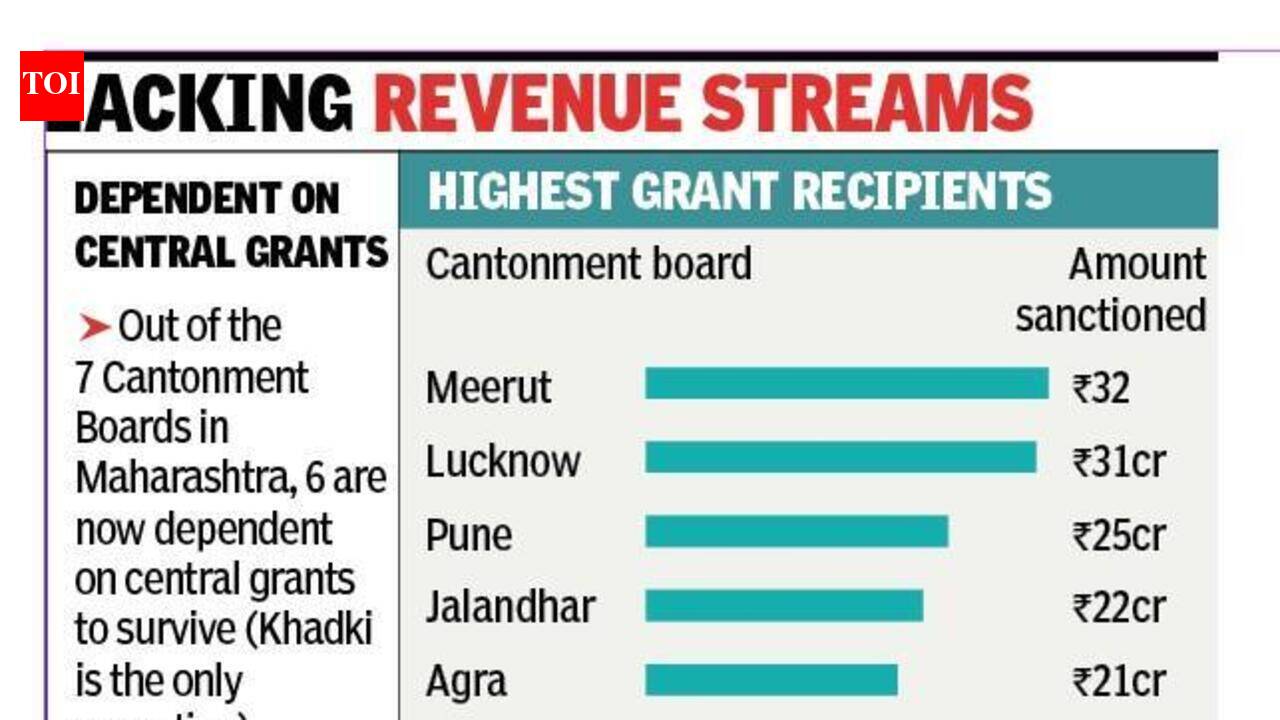
Pune: The Ministry of Defence (MoD) has sanctioned Rs420.95 crore as grant-in-aid to 49 deficit cantonment boards across India for the 2026-27 financial year. The move underlines the severe financial distress confronting military townships and raises fresh concerns regarding the long-term sustainability of the cantonment administration system.According to a June 16 order issued by the Directorate General Defence Estates (DGDE), these funds are earmarked exclusively for the payment of salaries and pensions for cantonment board employees. The allocation, which covers boards across six military commands, reflects an increasing dependence on central govt support for even routine operational expenditures.The figures reveal a significant fiscal challenge. Meerut (Rs32.18 crore) and Lucknow (Rs31.05 crore) are the largest beneficiaries, followed by Pune (Rs24.90 crore), Jalandhar (Rs22.43 crore), Agra (Rs20.79 crore), and Dehu Road (Rs19.28 crore).Cantonments under the Central Command account for nearly Rs195 crore of the total grant, while Southern Command boards received over Rs 141 crore.DGDE officials familiar with the matter stated that the grants highlight a widening mismatch between revenue generation and expenditure. Many boards have struggled to expand their revenue base due to taxation restrictions, shrinking income from defence land, and rising liability costs.“The fact that this grant is meant primarily for salaries and pensions shows that many cantonments are struggling to meet basic administrative commitments from internal resources,” a senior DGDE official told TOI on the condition of anonymity.Another official, who previously served as a chief executive officer for one of the affected boards, described the situation as a “structural financial challenge.”“These boards are under extreme stress because they lack diverse revenue streams. They cannot sustain basic functions, let alone fund major development projects,” the official added.Cantonment boards serve as local self-govts in notified defence areas, responsible for sanitation, roads, water supply, public health, and education. However, declining revenues and rising costs have plagued these bodies for over a decade. This financial strain has led to infrastructure delays, staff shortages, and mounting maintenance backlogs.In Maharashtra, all major cantonments, including Pune, Dehu Road, Deolali, Kamptee, Ahilyanagar, and Chhatrapati Sambhajinagar, are now dependent on central assistance, with the exception of Khadki. Pune Cantonment Board alone received one of the highest allocations in the country at Rs24.90 crore.Civic activists argue that the lack of financial autonomy is hurting the civilian populations living within these limits. “The situation is grim. Residents are increasingly demanding excision (merger) into nearby municipal corporations so they no longer suffer from these poor financial conditions,” said Rajabhau Chavan, a Pune-based activist.Defence estates officials said the grant is a statutory mechanism available under the Cantonment Board Accounts Rules, 2020, and is intended to ensure uninterrupted functioning of civic services.“The ministry is forced to grant aid every few months because there is no systematic reform in financial policy,” a senior Army officer said. “The govt needs to either introduce structural changes or grant these boards a share of the GST to make them self-sustainable.”Peter Durairaj, an activist from Secunderabad, echoed this sentiment: “This affects both the civilian and military populations. If these boards received a GST share from the state or central government, the financial crisis would be solved systematically. Instead of temporary aid, the govt must empower them financially.”