


NEW DELHI: Junk foods will soon carry warning labels highlighting high levels of salt, sugar and fat, with the Food Safety and Standards Authority of India (FSSAI) telling Supreme Court on Friday that it has agreed to red-coloured hexagonal warnings on the front of food packages to help consumers identify products high in specified nutrients of concern.FSSAI conveyed its position through a compliance affidavit filed before Supreme Court in response to the court’s Aug 13 order on front-of-pack labelling (FoPL).The move comes after the court pushed Centre to act on the issue, saying, “If the Union does it on its own, well and good, otherwise we shall proceed to pass further directions.”Under the framework, products high in specified nutrients would carry prominent red hexagonal warnings reading “HIGH FAT”, “HIGH SALT” and/or “HIGH SUGAR”, as applicable.FSSAI has agreed to exempt single-ingredient foods such as ghee, edible oil, salt, sugar, jaggery and honey from the proposed warnings, subject to applicable food safety and labelling regulations.The regulator has agreed to implement FoPL in phases, giving the industry time to reformulate products. Phase I would cover products high in two or more specified nutrients, while Phase II would extend warnings to products high in any one specified nutrient.
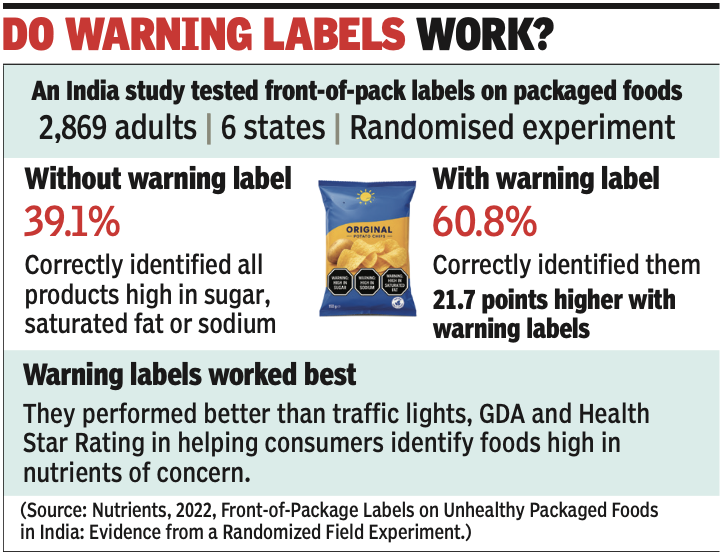
Do warning labels work?
The framework is based on nutrient thresholds specified under the Dietary Guidelines for Indians, 2024, issued by ICMR-NIN. The affidavit follows the Supreme Court’s observations on public health, particularly amid concerns over the rising prevalence of childhood obesity. The court said front-of-pack labelling could help consumers make informed purchasing decisions.
Share your thoughts in the comments
Be respectful · TOI community guidelines
The case stems from a PIL filed by NGO 3S and Our Health Society, which approached Supreme Court through advocate Rajiv Shankar Dwivedi, seeking front-of-pack labelling to help consumers make informed choices.FSSAI said the system is intended to provide a “simple, prominent and easily comprehensible warning” to consumers about food products high in specified nutrients of concern. It also cited international examples, including Chile and Canada, where front-of-pack labelling has been adopted.Supreme Court had considered options including coloured indicators, interpretative words, numbers, letters, symbols and percentages for front-of-pack labelling and directed Centre to take a decision and place it on record.