

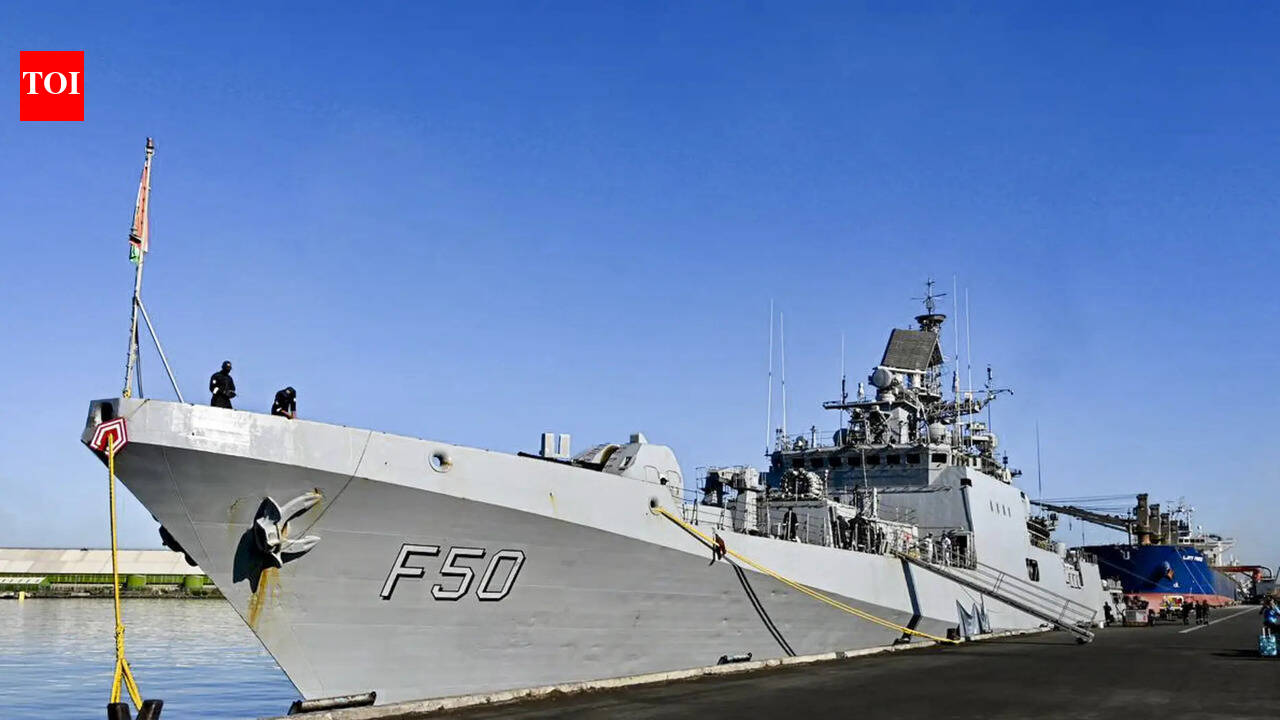
With both China and Pakistan strengthening their underwater arms, the Indian Navy is enhancing its underwater surveillance and anti-submarine warfare capabilities. The Pakistani Navy has recently inducted the first of eight Hangor-class submarines procured from China, while the Chinese Navy itself operates around 60 submarines.In light of this threat, the Indian Navy has issued a Request for Information (RFI) for a new system called the Containerised Theatre Level Sonar (CTLS). This advanced acoustic detection system, to be housed in standard ISO containers, will allow rapid deployment across different types of naval platforms without the need for major structural modifications. The flexibility of containerisation means the same system can be shifted between ships as operational needs arise.The CTLS is designed to detect and track submarines and other underwater targets over long ranges. The new system is expected to operate in both active and passive modes. In active mode, the sonar will emit low-frequency sound waves to identify and track targets. In passive mode, the system is expected to silently listen to noises generated by submarines.The active component, or the transmitter, will emit low-frequency signals, which are more effective for long-range detection. The passive component, on the other hand, will employ twin thin-line receiver arrays with at least 180 acoustic elements each, capable of capturing faint underwater sounds across a wide range of frequencies. Advanced digital signal processing, adaptive noise suppression and target motion analysis will help ensure accurate detection even in loud ambient sound conditions.The system is expected to be modular, enabling upgrades of active, passive and processing units as technology evolves. The Navy has also asked for artificial intelligence to assist operators in making faster and more accurate judgments. Predictive modelling software is also expected to be part of the system.CTLS is expected to integrate seamlessly with the Navy’s existing combat management and navigation systems. The Navy has specified a minimum service life of 15 years for the system, ensuring long-term operational utility.The Navy currently uses the Hull Mounted Sonar Array (HUMSA) on its ships. The system was developed by the Naval Physical and Oceanographic Laboratory and has been in service with the Navy since 2016.Besides this, the Defence Acquisition Council has cleared the procurement of six additional P-8I maritime patrol aircraft for the Navy, which currently operates a dozen of these aircraft. The P-8I is considered one of the most advanced submarine-hunting aircraft in operation.