


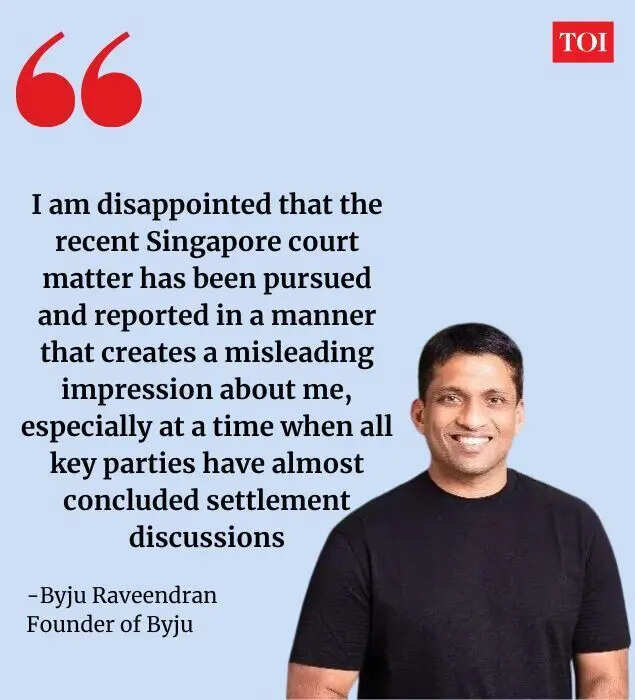
NEW DELHI: Edtech giant Byju’s has plunged deeper into crisis after founder Byju Raveendran was sentenced to six months in prison by a Singapore court in a contempt case linked to alleged non-compliance with court orders regarding disclosure of assets and ownership records.The ruling marks the latest setback for the entrepreneur, who is already battling multiple legal disputes across India, Singapore and the United States over alleged fund diversion, unpaid dues, insolvency proceedings and creditor claims tied to the collapsed edtech empire.Once valued at nearly $22 billion and hailed as India’s biggest startup success story, Byju’s is now facing one of the steepest corporate downfalls in the country’s startup ecosystem.Reacting to the Singapore court’s decision, Raveendran said, “I am disappointed that the recent Singapore court matter has been pursued and reported in a manner that creates a misleading impression about me, especially at a time when all key parties have almost concluded settlement discussions.”
.
He claimed that discussions are underway to resolve disputes involving the company’s lenders and investors.“The lenders, including GLAS Trust and QIA, as well as other stakeholders, have been in discussions with the founders and other parties. A settlement has been agreed in principle, with only a few residual minor issues left to be finalised between certain parties. I have no role in those remaining issues,” he added.Also Read | Byju Raveendran reacts to Singapore court order: ‘Cannot allow false & one-sided narrative to go uncontested’ – read full statement
Why was Byju’s founder sentenced?
According to Bloomberg, the Singapore court held Raveendran guilty of contempt after finding that he repeatedly failed to comply with court directions issued since April 2024 regarding disclosure of assets connected to Beeaar Investco Pte, an entity linked to investments in affiliated companies.Apart from the six-month jail sentence, the court also directed him to pay legal costs amounting to around S$90,000 and furnish documents establishing ownership structures tied to the investment entity.The case is part of a larger legal battle involving overseas investors and lenders pursuing recovery proceedings against Byju’s and its founder across multiple jurisdictions.
How Byju’s became India’s biggest edtech company
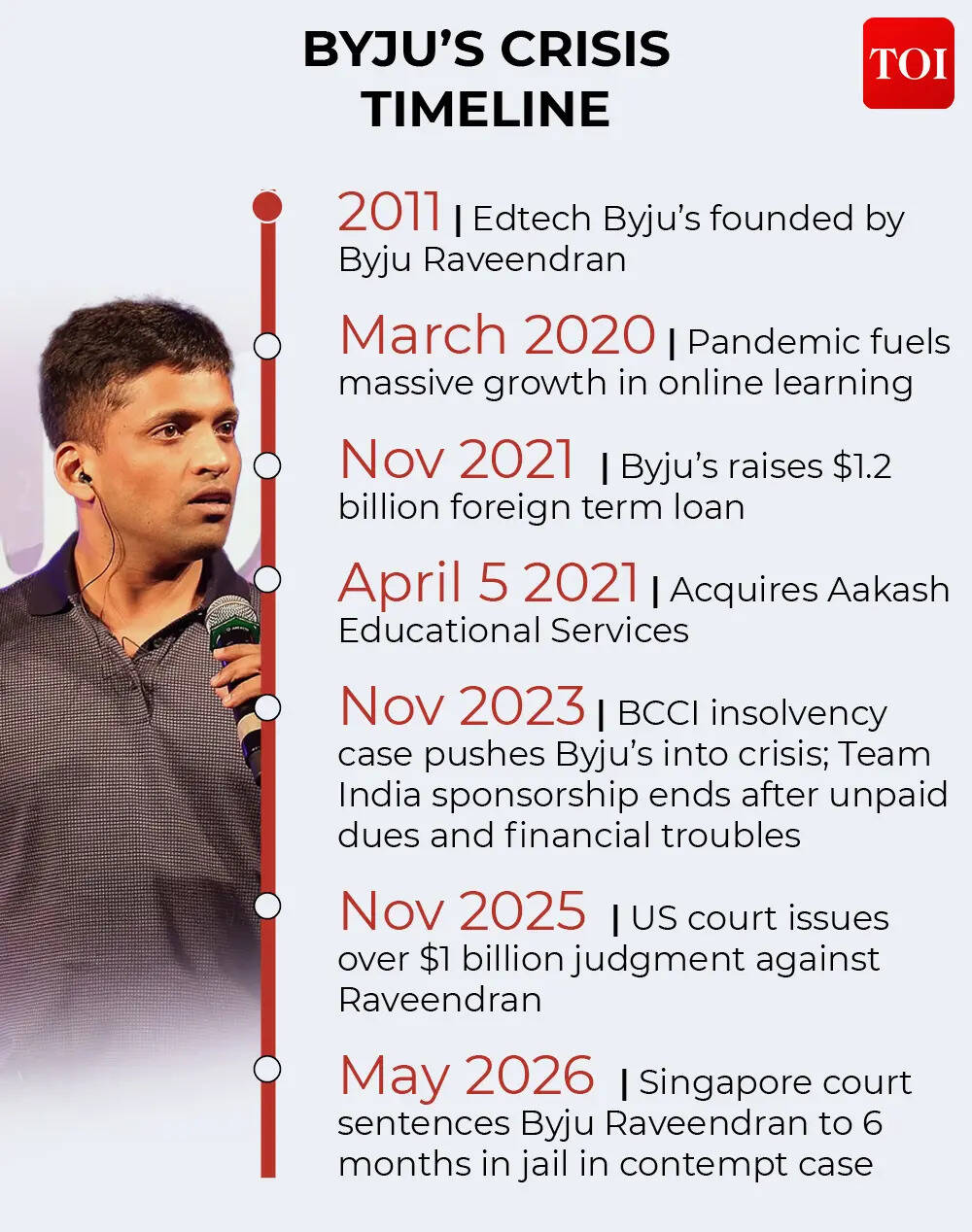
Founded in 2011 as Think & Learn Pvt Ltd, Byju’s began as an online learning platform focused on school education and competitive exam preparation.The company gained massive traction during the Covid-19 pandemic as online learning became mainstream across India and several international markets.Aggressive expansion, celebrity endorsements and billion-dollar acquisitions transformed the startup into a global edtech powerhouse.The company acquired firms such as Aakash Educational Services, Great Learning and Epic as it attempted to dominate both digital and offline education segments.At its peak, Byju’s became the face of India’s startup boom, attracting billions of dollars from global investors and turning Raveendran into one of the country’s most high-profile entrepreneurs.Much of Byju’s rapid expansion, however, was fuelled by aggressive spending and debt-backed growth rather than sustainable profitability.The company spent heavily on acquisitions, international expansion and marketing campaigns while relying on continuous fundraising to maintain momentum.As pandemic-driven demand for online learning slowed, structural weaknesses within the business began to surface.Revenue growth weakened sharply while operational costs remained extremely high.The company’s dependence on expensive acquisitions and debt financing soon became a major burden.
What went wrong
One of the biggest triggers behind Byju’s crisis was the $1.2 billion term loan raised in the United States in 2021 for global expansion.The loan later became the centre of a massive legal dispute after lenders accused the company of violating debt covenants, delaying financial disclosures and transferring hundreds of millions of dollars without adequate disclosure.US lenders alleged that nearly $533 million in loan proceeds were moved through obscure investment structures and offshore entities beyond the reach of creditors.The dispute escalated into a prolonged legal battle in American courts, with lenders accusing the founder and company executives of concealing funds and obstructing investigations.
.
A Delaware bankruptcy court later entered a default judgment of more than $1.07 billion against Raveendran after finding repeated non-compliance with court-ordered discovery related to the movement of funds tied to Byju’s Alpha, the company’s US subsidiary.The court also ordered a complete accounting of how the disputed funds were transferred through various entities and investment vehicles.Raveendran has denied wrongdoing and said the money was used for legitimate business purposes rather than personal enrichment.
Allegations of offshore fund transfers
Court filings in the US further intensified scrutiny around Byju’s financial operations.Creditors alleged that large sums linked to the company’s loan proceeds were routed through offshore trusts, OCI Ltd and Camshaft Capital Fund in ways that made recovery difficult.In another explosive filing, businessman William R Hailer alleged that Raveendran attempted to regain control of parts of the collapsing edtech empire by trying to buy distressed debt from creditors.According to the filing, the discussions allegedly involved efforts to regain ownership of key assets such as Epic through debt restructuring arrangements.Raveendran has strongly denied the allegations and accused lenders of using aggressive legal tactics.He has announced plans to challenge the rulings through appeals and a separate damages claim reportedly worth $2.5 billion.
BCCI payment crisis and insolvency proceedings
Another major blow for Byju’s came from its sponsorship agreement with the Board of Control for Cricket in India, which once played a key role in building the company’s brand visibility.The edtech company failed to clear dues of nearly Rs 159 crore owed to the cricket board.That dispute became a major trigger for insolvency proceedings, exposing the company’s severe liquidity stress and inviting further scrutiny from creditors.Creditors also approached US courts seeking to block settlement efforts involving BCCI dues, arguing that such payments could affect their own recovery claims.
Battle for control of Aakash
The acquisition of Aakash Educational Services was initially viewed as one of Byju’s most strategic deals, helping the company strengthen its test-preparation business and offline education presence.However, the asset later became central to a major governance and ownership battle.As insolvency proceedings intensified, Aakash proposed a rights issue to raise fresh capital.Since Think & Learn was under insolvency proceedings and unable to fully participate, its stake risked massive dilution.Legal challenges reached the Supreme Court, which eventually allowed the rights issue process to continue.If Byju’s holding falls below a certain threshold, the company could effectively lose control over one of its most valuable remaining assets.
Criticism over sales culture and operations
Even during its growth phase, Byju’s faced criticism over aggressive sales practices and a pressure-driven work culture.Former employees and reports alleged that sales teams were pushed to aggressively market expensive educational packages to families, sometimes encouraging financing arrangements that later became difficult for customers to manage.The company denied several allegations, describing them as isolated incidents during a period of rapid expansion.However, the criticism added to growing concerns over the sustainability of its business model.As layoffs increased and financial troubles worsened, operational instability further hurt consumer confidence and weakened the company’s chances of revival.
Bottom line
Today, Byju’s faces mounting legal battles, insolvency proceedings, creditor pressure and collapsing valuations.Investors have exited the board, funding avenues have narrowed, and multiple courts across jurisdictions are examining allegations linked to fund transfers and governance failures.What was once considered the crown jewel of India’s startup revolution is now increasingly viewed as a cautionary tale about unchecked expansion, debt-fuelled growth and corporate governance failures in India’s startup ecosystem.