

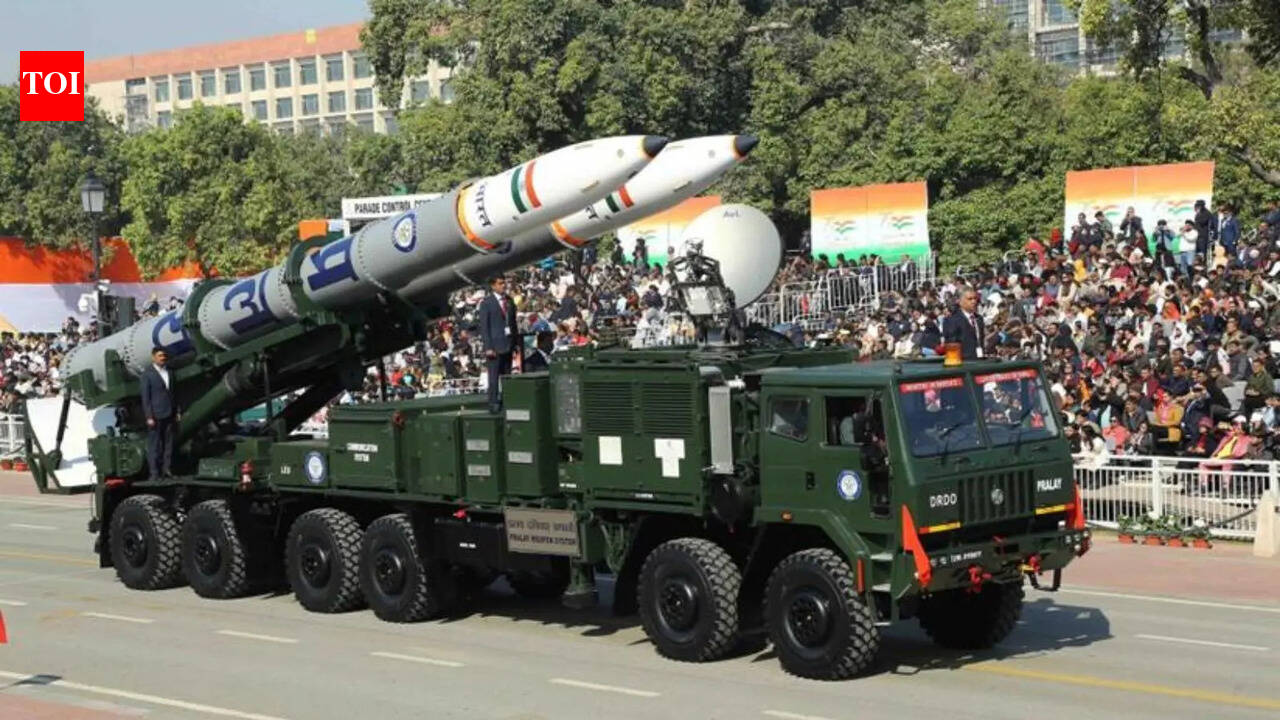
India struck terror targets deep inside Pakistani territory in response to the terror attack on unarmed civilians in Pahalgam, . Right after the pinpointed attack on the nine terror targets, (seven by the army and two by the air force) the Pakistanis hit back, with the tempo of operations reaching a crescendo on May 10. The Pakistanis launched rocket attacks on India that were intercepted by air defence missiles near the Sirsa air base. Within the next few hours a series of missile and drone strikes destroyed Pakistani air defence sites and precise Brahmos missile strikes neutralised key Pakistani air bases, hampering the ability to launch fighter aircraft till the runways were fixed. Soon afterwards the hotline connected between the Director Generals of Military Operations, started ringing in Delhi and the rest is history.Operation Sindoor ushered in the era of non-contact and non-kinetic warfare in the Indian sub-continent. This means that the large force on force combat that has been the way wars have been fought since times immemorial. This sort of engagement which required strength (both in men and material) to be concentrated at one point, led to large number of casualties. Both the conflicts mentioned above were noted for the use of drones, loitering munitions and missiles. India, demonstrated its ability to dominate the escalatory ladder in a conflict. More New Delhi showed how it could terminate a conflict at its terms.The Americans too started a non-kinetic and a non-contact conflict with Iran in February and now in the middle of July, the world is still waiting for conflict resolution in order to calm the global energy market.
Longer reach and a stronger punch
The Indian armed forces, in the middle of a modernisation drive are enhancing their capabilities to maintain their combat edge in the region. A critical requirement for the combat of the future is the ability to engage the enemy at ever increasing ranges. The tactical engagement ranges of weapons employed by the armed forces are continuously increasing, even down to the humble rifle, optics have made the rifleman more accurate and has given him the ability to shoot at greater distances both during the day as well as the night.In the same manner, from guided artillery shells to rockets to missiles, have taken great leaps in both accuracy and range. The army has inducted different types of long ranged weapons such as the Pinaka, Smerch, Pralay and the Brahmos. These weapons are continuously improving the reach of the army, with the latest under-development version of the Pinaka, called the Long Range Guided Rocket, to 120 km while the newest iteration of the existing Brahmos will extend the range of this weapon to as far as 800km.These weapons are critical for any future conflict. The army has traditionally depended on the air force for interdiction missions deep inside enemy territory. These high profile missions include the destruction of the adversary’s command and control centres, ammunition dumps, transportation networks (such as bridges) and other logistics hubs. These operations hamper the enemy’s ability to perform optimally at the forward edge of the battle area. The destruction of Pakistani air defence radar network had similarly degraded the ability of form a complete aerial picture, thereby reducing cohesiveness and combat effectiveness.Now in the era of air defence systems that can shoot down aircraft hundreds of kilometers away, as proven by India during Operation Sindoor, when an S-400 system destroyed a Pakistani air force aircraft well over 300 km away from the firing battery. It is important to limit the use of combat aircraft, especially non-stealth aircraft, in the face of a comprehensive air defence network, as operated by China. This at a time when the Indian air force is already struggling with a shortage of fighter aircraft. Also, by deploying missiles against many of these targets, the air force could use their fighters to perform other tasks.The ranges afforded by these long range weapons give the ability to reach out to any part of Pakistan, as was elucidated by defence minister Rajnath Singh, but these missiles can also hit most of Chinese logistic nodes on the Chinese G318 highway which moves alongside the Indo-Tibet border at depths of 200-500 km from the border, but is much closer to the Line of Actual Control across south east Ladakh.As mentioned above, to hit one first has to see, or as the old adage goes ‘you can’t hit, what you can’t see’. The army is investing in Unmanned Aerial Systems and is likely to depend on upcoming systems such as the constellation of India’s satellites under Space-Based Surveillance Phase-3, Stratospheric Airship Platform and the High Altitude Pseudo Satellites (HAPS). Most of these systems are is some stage of development, while a constellations of over 50 satellites is to be made operational by 2029. This satellite constellation project, spearheaded by tri-services Defence Space Agency, will provide a detailed intelligence picture of the frontiers, both with China and Pakistan.
What the army brings to the table
The army has a series of tactical long range weapons that can be used to hit targets deep inside enemy territory. These weapons, can reach out to as far as a thousand kilometers. At that range most important and battle supporting assets will be well within Indian reach.
Long Range Land Attack Cruise Missile
The yet to be inducted Long Range Land Attack Cruise Missile (LRLACM), has a stated range of over 1,000 km. This yet to be inducted missile has gone through at least 15 flight tests. The last of these tests was conducted last month. The missile, launched using a rocket booster, uses an indigenously developed Small Turbofan Engine (STFE) Manik developed by the Gas Turbine Research Establishment (GTRE). this weapon is designed to carry a warhead weighing 450kg. This subsonic missile follows a low-level terrain following flight path in order to protect itself from enemy defences.
Brahmos
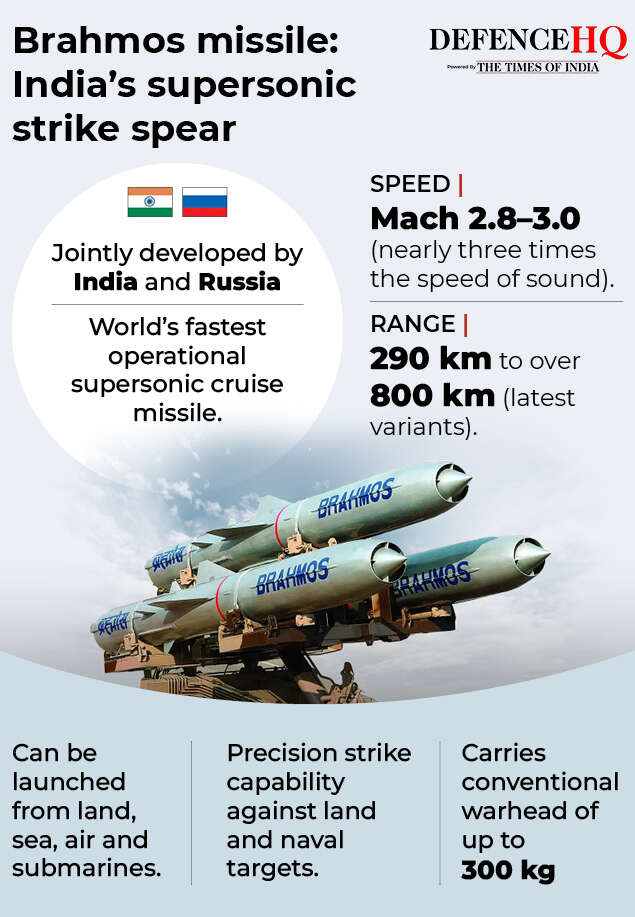
Brahmos missile
This missile is currently in operational use with the Indian army. This battle proven missile can fly at three times the speed of sound and is very accurate. The Brahmos can carry a warhead weighing as much as 300kgs to a range that is being increased to 800 km. The missile follows a terrain hugging flight path at supersonic speeds to get through to its target.
Pralay
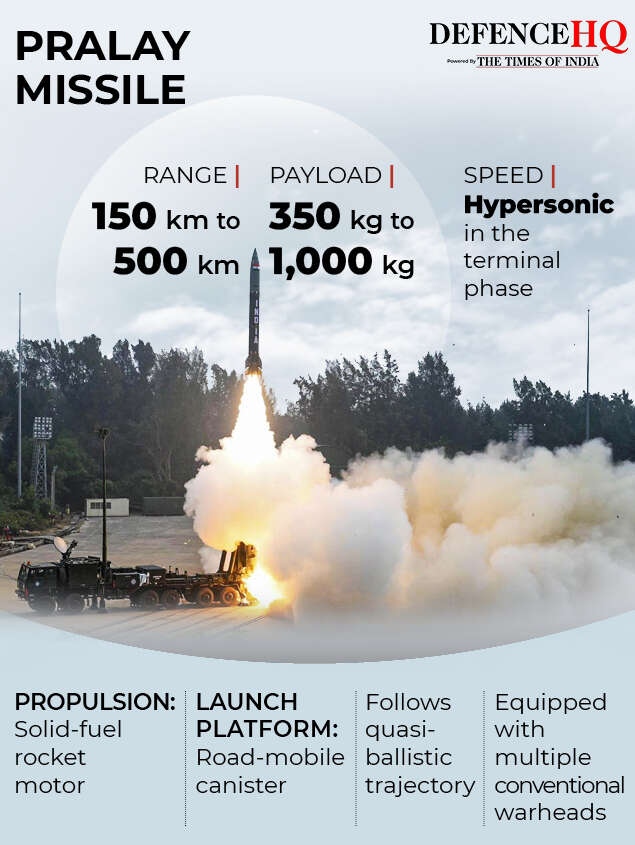
The Pralay is a quasi-ballistic missile with a range of 500km. It is designed to carry a conventional warhead. The missile maneuvers at the end of its ballistic trajectory in order to throw off ballistic missile interceptors that have been fired to engage this weapon in the terminal stage.
Pinaka
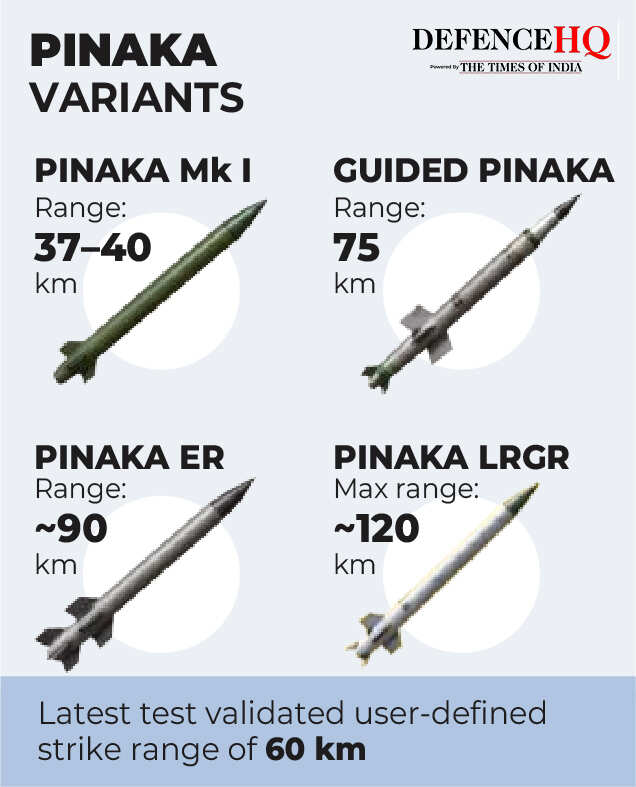
Pinaka varients
The Long Range Guided Rocket variant of the Pinaka has a range of 120 km. A launcher can fire as many as a dozen rockets in a span of 44 seconds. The weapon can be used to either saturate an area with large volume of fire or be used to pick out multiple targets with precision in less than a second. The Pinaka rocket can be fitted with a ramjet rocket that gives the rocket the ability to hit targets at ranges of up to 240 km. The Pinaka round, although not cheap, is cheaper than all of the systems listed above.
Loitering munitions: the flying hunters
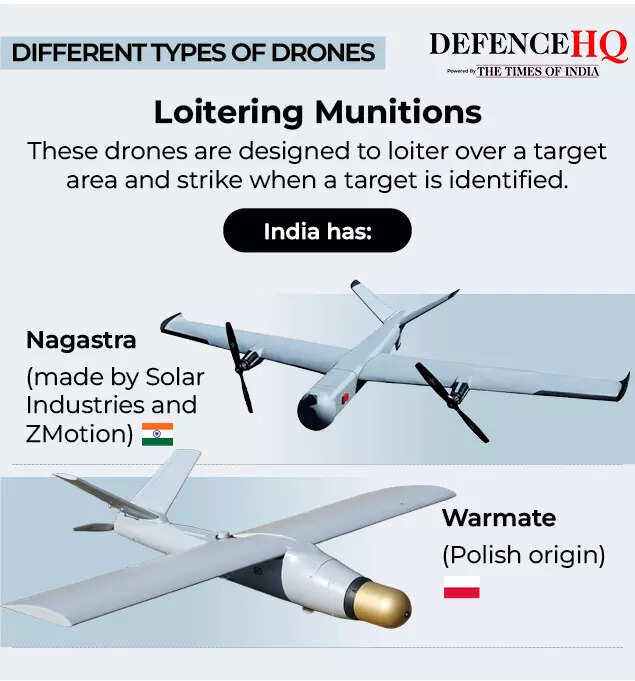
The army is inducting drones and loitering munitions in ever increasing numbers. The army has recently given orders to procure SkyStriker drones, these loitering munitions were used during Operation Sindoor. The army has also procured Polish Warmate loitering munitions in the past. The army has also ordered Johnnette JM-1 loitering munitions and the Nagastra-1 loitering munitions to engage targets in depth.The army’s focus on long-range vectors comes from operational necessities and realities. The army is building a weapons portfolio, which complements the strengths of its sister services. As warfare moves to a new paradigm that focuses more on effects than on mass, the army is evolving with the trend, ensuring that in any conflict in the future, the armed forces could control the escalation ladder and terminate the conflict on its own terms.

