
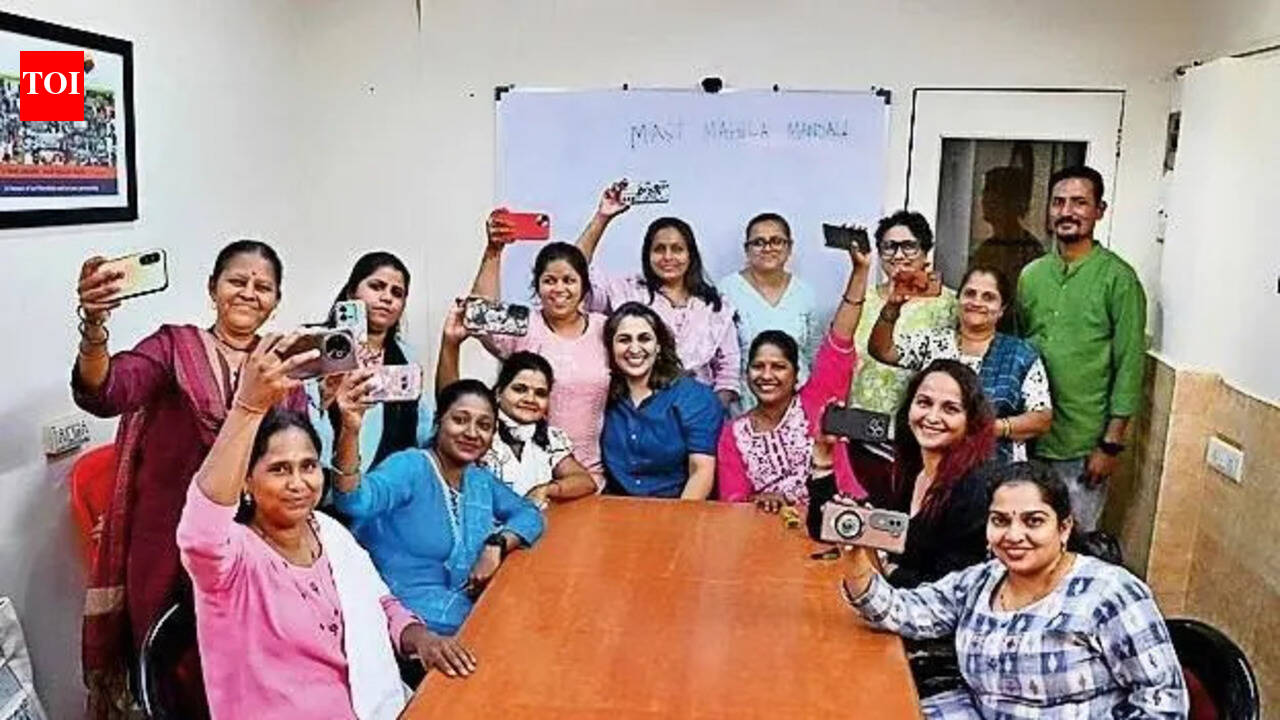
Recording ka button kidhar hai, Madam?” Laughter erupts. This is how the documentary Mast Mahila Mandali (Cool Ladies Club) begins. With women having fun. In 2024, ten women from ten bastis in Mumbai’s M East ward participated in an experiment in filmmaking—they were to document each other’s lives for a feature-length film, shot entirely on smartphones. What began in kitchens, maidans, and gullies has, two years later, found its way to a public premiere—on April 28 at Regal Cinema. “My family knew I was making a film, but they didn’t know I’ll be on screen. My scenes were shot when no one was home,” grins 35-year-old Vaishali Mane. She spilled the beans to her husband a day before the team came over with an invitation card to the premiere. He was shocked to learn about her secret enterprise. A week before the screening, the ten filmmakers, along with their Chief Facilitator and Co-Director Shilpi Gulati and producer Supriya Jan, gathered for their first media interview at the Chembur office of the nonprofit CORO India. “The idea, initially, was to document the learnings of CORO’s Right to Pee campaign, a 15-year grassroots development programme built on access to clean, safe toilets in working-class neighbourhoods,” says Jan, the Lead for CORO’s Grassroots Knowledge Building Initiatives. An open call was issued to community women, inviting them to submit five photographs shot on their phones of anything that caught their eye. “We wanted to understand how they look at everyday life,” says Gulati. Fifty entries were pared down to ten, with a mix of community toilet operators, community health volunteers, sanitation workers and homemakers. Every Saturday for 18 months, the women would assemble in the CORO office in Shell Colony, Chembur, for lessons in filmmaking, led by Gulati, a National Award-winning filmmaker and faculty member at the School of Media and Cultural Studies at TISS. They were paired up and each pair handed a smartphone. On the very first day, Gulati asked the team what film they wanted to make. While many wanted to keep toilets at the centre, the focus shifted over the course of the workshop. As they filmed one another, they began to foreground themselves—as lynchpins of development in their communities and fulcrums of their families. “We didn’t want people to turn on their TVs to see toilets, toilets, toilets everywhere,” said Nazneen Siddiqui, one of the directors. “We wanted to show how the women themselves were living their lives,” says Gauri Rane. The vignettes they shot would reflect the individual.The phones were provided by a research project titled ‘Gendered Access to Digital Technology’ currently active at TISS and led by Gulati. “We didn’t realise that an entire film could be shot on a phone,” marvels Kavita Ghuge. Alongside lessons in the techniques of phone filmmaking were discussions on the art of interviewing, participatory storytelling and the feminist impulses shaping what they wanted to capture, and how.“Initially, we were unsure about what we wanted the film to say, but we were certain of one thing—it shouldn’t be a rona-dhona film about how run-down the bastis are or how wretched our lives are,” says Anjum Shaikh. And so, the women are seen playing kabaddi, taking joyrides on their bikes, heading to the gym, and dancing. In one winning scene, her hair wrapped in a towel, Rehana Shaikh, Anjum’s sister, dances with abandon in her kitchen to Aaj Ki Raat. “Dancing helps me forget my problems. My husband says I shouldn’t dance because I’ve become fat. He says the ground shakes when I dance. But I won’t stop.” Darshana Mayekar says that without a script, they plotted scenes, visualised how to shoot them and framed interview-style questions for each other. “How do you manage your day job and housework?” Rane asks Sheetal Navle. “It has to be done, so I do it. Sometimes, I ask my husband and kids to pitch in, but my husband complains, ‘This is what you learn at your training?’ I point out that if I can do his work, why can’t he do mine?” The film shines with small acts of routine rebellion. It occasionally lights up with love. When asked what love means, Kavita Khomne shyly responds, “To be there for each other. I am proud of my navra (husband).” And glows with homegrown wisdom. “Adjustment is an art only women know well,” says Navale wryly. In a telling scene, Nazneen Siddiqui rides a bike with Kadam and Khomne perched pillion—the latter shooting them on a selfie stick. “If we meet with an accident, which of us four will you save?” she asks Siddiqui. “But there are only three of us,” Kadam points out. “The phone’s the fourth. Jaan jaye, magar phone na jaye.” In their hands, the phone transforms to an all-access pass to their inner lives. Siddiqui says: “We didn’t all know each other and were initially hesitant to share our lives with strangers.” Now that the film is complete, they are excited to see how it will be received. “When filming in our communities, people wanted to know what we were filming and why,” recalls Usha Deshmukh.