

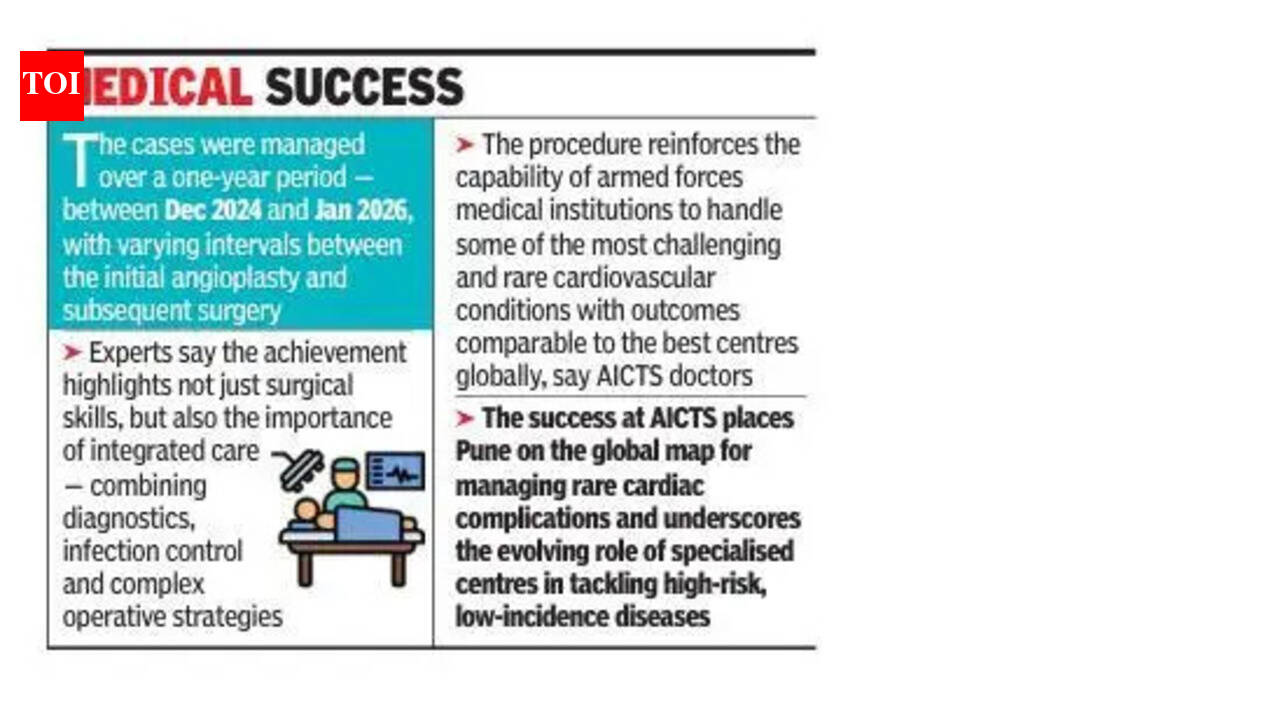
Pune:A team of doctors from the Army Institute of Cardiothoracic Sciences (AICTS) successfully treated four patients suffering from an exceptionally uncommon and life-threatening condition called coronary stent infection of which fewer than 50 cases have been documented globally.The condition is medically referred to as post-percutaneous coronary intervention, coronary artery aneurysm or coronary stent infection. It is associated with high mortality and remains poorly understood, because it is rare. The four patients had undergone angioplasty procedures at different civil and private hospitals initially, before being referred to the AICTS for advanced management.Each case presented unique surgical challenges that required meticulous planning and execution between Dec 2024 and Jan, said doctors.A senior cardiothoracic surgeon at AICTS told TOI: “”The complication is extremely rare and potentially fatal. Globally, the evidence is limited to isolated case reports and small series. Managing even a single case is demanding, treating four successfully was significant. All of them have recovered well.”The surgical approach involved either extraction or exclusion of the infected coronary stent aneurysm, followed by coronary artery bypass grafting beyond the affected segment to restore blood flow. Procedures lasted between three-and-half to five hours, depending on the complexity.According to medical literature, coronary stent infections carry mortality rates of up to 40%, particularly when diagnosis or intervention is delayed. The rarity of the condition often leads to under-recognition, increasing the risk of severe complications, including sudden cardiac death.Former head of the department of heart surgery at the BJ medical college Avinash Inamdar told TOI: “Such cases are rare. The fact that it could be treated is a big positive. One or two such patients had approached us for consultation in the past. However, AICTS’s success could help provide standard operating procedures, which will be useful for private hospitals too. It is a boon for cardiologists in India.”“Early diagnosis is critical. The infection can happen within days of stent placement.The onset ranged from as early as one day to about two weeks in our four patients,” said another doctor involved in the treatment.All patients had received drug-eluting stents earlier. Experts said these may carry a higher risk of infection due to delayed healing of the vessel lining. It can leave parts of the stent exposed, creating a potential site for bacterial colonisation.Doctors attributed such infections to multiple risk factors, including breaches in sterile protocols, repeated vascular access, prolonged catheter use or existing infections elsewhere in the body. The most common pathogens suspected are Staphylococcus aureus and Pseudomonas species.The treatment protocol at AICTS combines early imaging with aggressive medical and surgical intervention. Coronary angiography is used as the first-line diagnostic tool, followed by CT coronary angiography for surgical mapping and PET-CT scans to pinpoint infection sites. Patients are treated with a four-week course of targeted antibiotics. However, in cases involving complications such as aneurysm formation or persistent infection, surgery becomes unavoidable.A member of the doctor’s team said, “Surgical management involves complete removal of infected material, debridement of surrounding tissue and revascularisation through bypass grafting. Precision is key because of the high-risk anatomy involved.”