
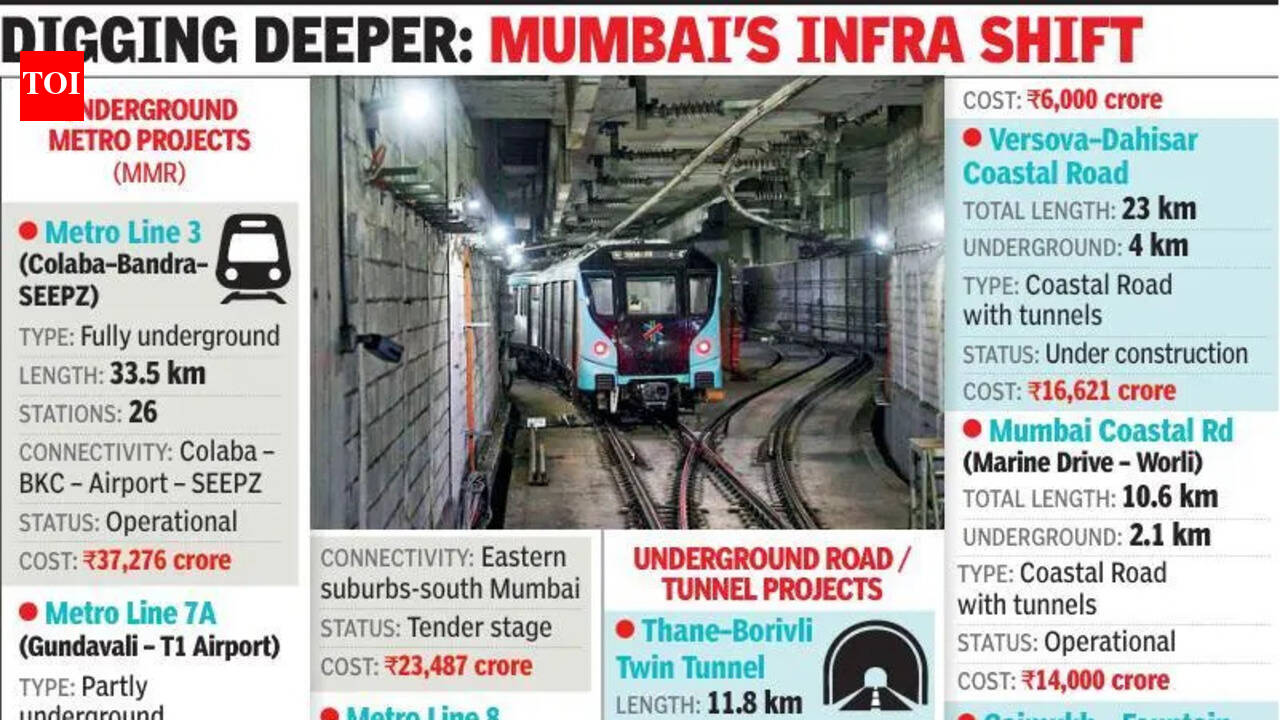
Mumbai: Mumbai’s suburban rail network may be headed for a structural overhaul, with Western Railway (WR) and Central Railway (CR) planning feasibility studies for underground corridors along the heavily loaded Churchgate-Virar and CSMT–Kalyan stretches.WR has already sought approval from the railway board to undertake the study for its corridor, while CR is expected to follow suit for the CSMT–Kalyan section.The push for going underground is driven by multiple constraints on the existing-network. Officials said adding more surface lines has become increasingly difficult due to high land acquisition costs, dense urban development and litigation that often delays execution. “We are reaching a saturation point on surface expansion. Underground corridors offer a way to add capacity without the usual bottlenecks of land and encroachments,” a senior railway official said.Underground corridors, though capital-intensive, can bypass these hurdles while creating parallel capacity. They would also allow segregation of suburban services from goods and long-distance trains, improving punctuality and enabling a modern, fully air-conditioned suburban system. “A dedicated underground suburban system will ensure higher frequency, better reliability and a significant reduction in overcrowding,” the official added.Railways are also drawing confidence from the successful execution of underground infrastructure projects in Mumbai, particularly Metro corridors such as the Aqua Line, which have demonstrated the city’s ability to undertake complex tunnelling works in dense urban conditions. “The success of underground Metro corridors has shown that such engineering challenges can be managed efficiently. That experience is encouraging us to explore similar solutions for suburban rail,” the official said.Another key objective is to reduce the “super-dense crush load” — a term used to describe extreme overcrowding in Mumbai’s local trains. Globally, including in countries like the United States, a density of five standing passengers per square metre is considered a crush load. In Mumbai’s suburban trains, the benchmark itself is higher at around six persons per square metre. During peak hours, however, the system routinely experiences “super-dense crush load” conditions, with as many as 16 passengers standing within the same space — many of them carrying bags on shoulders, in hand or slung across their bodies.Officials also pointed out that frequent technical failures on the existing network exacerbate congestion. “Any disruption — whether due to signalling glitches, overhead equipment (OHE) failures, track issues or trespassing — has a cascading effect on the entire corridor, leading to bunching of trains and severe delays,” an official said. An underground system, with better access control and dedicated infrastructure, is expected to minimise such disruptions.By adding a new layer of capacity beneath existing corridors, authorities aim to ease pressure on the current network without disrupting services. The approach mirrors systems in cities such as London and Tokyo, where multi-level rail networks efficiently handle high commuter volumes.In Mumbai, underground metro corridors cost around Rs 1,100 crore per km—nearly 3–4 times higher than elevated lines at Rs 250–300 crore per km.WR currently operates suburban services between Churchgate and Dahanu over a 120-km stretch, running around 1,414 services daily. The Churchgate–Virar section, approximately 60 km long, carries close to 30 lakh passengers daily, compared to about 35 lakh before the pandemic. The proposed underground alignment is expected to run parallel to the existing corridor.On CR, suburban services run between Chhatrapati Shivaji Maharaj Terminus (CSMT) and Karjat/Kasara, with around 814 services catering to nearly 38 lakh passengers daily, down from 45 lakh pre-Covid. The CSMT–Kalyan stretch, spanning about 54 km, continues to face capacity constraints despite multiple track additions.At present, WR has four lines between Churchgate and Marine Lines and between Borivli and Virar, while fifth and sixth lines operate between Mumbai Central and Borivli. The Mumbai Railway Vikas Corporation (MRVC) is extending additional lines between Borivli and Virar and adding third and fourth lines between Virar and Dahanu.Similarly, on CR, four lines exist between CSMT and Kurla, with fifth and sixth lines under construction between Parel and Kurla. Beyond Parel, six lines are already operational up to Kalyan. Despite these expansions, demand continues to outpace capacity.Parallelly, MRVC has commissioned a feasibility study for a 5-km underground stretch between Churchgate and Mumbai Central. MRVC managing director Vilas Wadekar said, “We have commissioned a feasibility study to ascertain the financial and technical viability of an underground corridor between Churchgate and Mumbai Central. The final decision will be taken jointly by the ministry of railways and the state govt.“Officials said the findings of these studies will determine whether Mumbai’s suburban railway — often described as the city’s lifeline — can transition into a multi-tier network to meet future demand.