

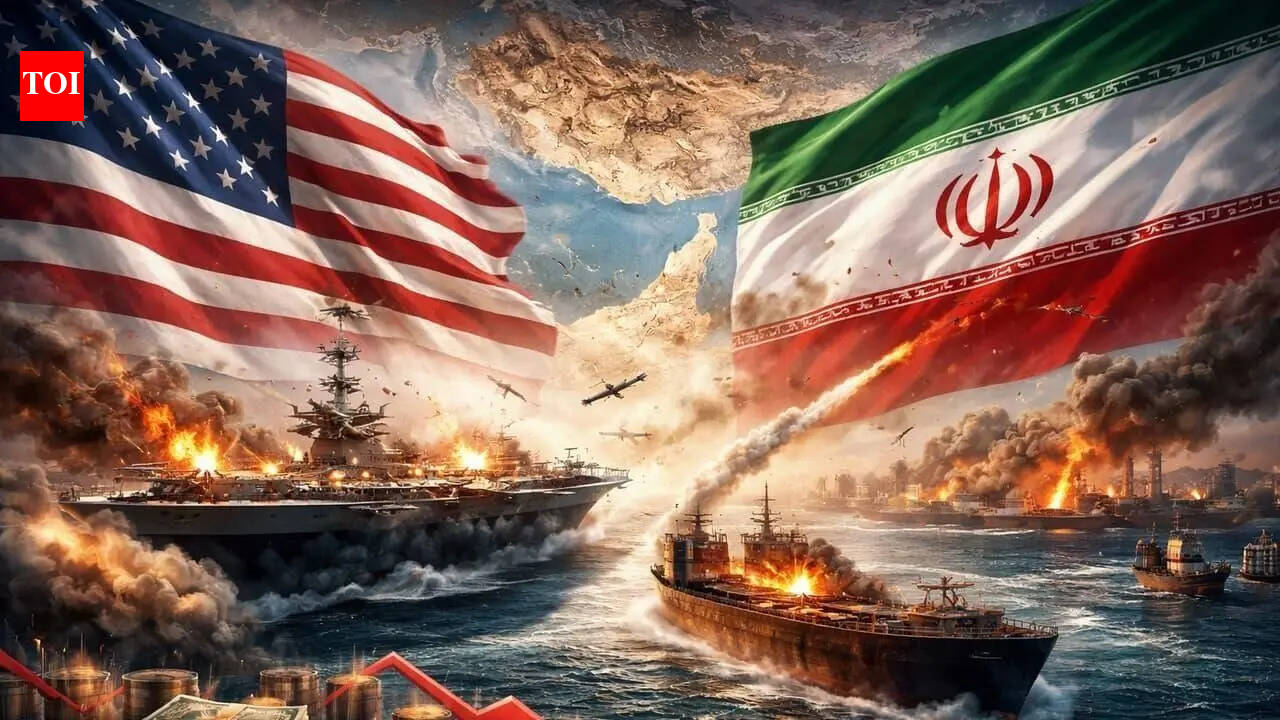
War beyond kinetics: The cognitive battlespace
The ongoing confrontation between the United States and Iran is no longer defined solely by missiles, drones, or precision strikes. It has evolved into a far more complex contest—one that is being fought simultaneously in the cognitive, informational, and psychological domains. While the physical battlefield remains active, the decisive struggle is unfolding in the realm of perception, where narratives, signalling, and calculated mind games shape the trajectory of conflict.This transformation reflects a deeper shift in the nature of warfare. As Carl von Clausewitz observed, war is fundamentally political. In the contemporary context, that political dimension is increasingly executed through strategic communication and perception management, turning narratives into operational weapons.
Narrative warfare: Competing realities
At the heart of the U.S.–Iran conflict lies a clash of narratives. Each side is not merely reporting events—it is constructing a version of reality designed to influence audiences at multiple levels.The United States projects a narrative of controlled escalation and operational dominance. Its messaging emphasizes precision strikes, degradation of Iranian capabilities, and a posture of strategic restraint combined with readiness for negotiation. This framing is intended to reassure allies, maintain domestic confidence, and signal inevitability to Tehran—that continued resistance will only deepen its strategic disadvantage.Iran, by contrast, advances a narrative rooted in resistance and endurance. It portrays itself as a victim of aggression while simultaneously demonstrating its capacity to retaliate through sustained missile and drone operations. The emphasis is not on immediate victory but on survival, resilience, and moral legitimacy. In this framing, the mere ability to continue fighting becomes a form of strategic success.These competing narratives are not static; they are continuously adapted in response to battlefield developments, international reactions, and domestic pressures. The result is a dynamic contest to define the meaning of events, rather than just the events themselves.
Strategic Communication as a force multiplier
Strategic communication has emerged as a critical instrument in amplifying or mitigating battlefield outcomes. It operates through carefully calibrated messaging that integrates political objectives with military actions.The United States employs coercive communication, combining demonstrations of capability with signals of diplomatic openness. This dual approach is designed to create psychological pressure—projecting strength while leaving space for negotiation.Iran, on the other hand, leverages asymmetric communication, emphasizing its ability to absorb damage and continue operations. This approach seeks to undermine the credibility of U.S. claims and shift the narrative from dominance to stalemate.As Sun Tzu famously noted, “All warfare is based on deception.” In the current conflict, deception is not limited to battlefield manoeuvres; it is embedded within the very structure of communication.
Mind Games: The invisible battlefield
Beneath the visible layer of narrative warfare lies a more subtle and decisive dimension—the domain of strategic mind games. These are deliberate efforts to manipulate the adversary’s perception, distort decision-making processes, and influence strategic choices without direct confrontation.Mind games are not improvised tactics; they are structured instruments designed to shape how the opponent interprets reality. Their effectiveness lies in their ability to operate below the threshold of overt conflict, influencing outcomes without triggering escalation.In the U.S.–Iran context, mind games manifest in multiple forms, each targeting specific psychological vulnerabilities.
Perception engineering and the construction of reality
One of the primary mechanisms of mind games is perception engineering—the deliberate construction of a reality that serves strategic objectives. Both sides selectively highlight successes, downplay setbacks, and frame events in ways that reinforce their narratives.For the United States, this involves projecting technological superiority and operational control. For Iran, it involves demonstrating resilience and continuity of capability. The objective in both cases is to influence not just what the adversary knows, but how the adversary interprets what it knows.When perception is successfully engineered, it begins to shape decision-making. The adversary responds not to objective reality, but to the constructed version of reality presented to it.
Strategic ambiguity and psychological pressure
Another critical element of mind games is strategic ambiguity. By withholding clarity and introducing uncertainty, actors create psychological pressure on their opponents.Ambiguous troop movements, unexplained political statements, and partial disclosures generate a state of cognitive tension. Decision- makers are forced to operate under uncertainty, constantly reassessing risks and intentions. This uncertainty can lead to hesitation, overreaction, or miscalculation—all of which can be exploited.In the current conflict, both sides have used ambiguity as a signalling tool, ensuring that the adversary remains uncertain about thresholds, intentions, and next moves.
Controlled escalation: Calibrated psychological stress
The pattern of escalation in the U.S.–Iran conflict reflects a deliberate strategy of calibrated pressure. Rather than pursuing full-scale confrontation, both sides engage in limited, targeted actions designed to signal capability without crossing critical thresholds.This creates a cyclical pattern of tension and release, maintaining constant psychological pressure. The adversary is never allowed to settle into a stable equilibrium, and the risk of escalation remains ever- present.Such controlled escalation serves as a mind game by: Keeping the opponent off balance, sustaining uncertainty about future actions and reinforcing perceptions of capability and resolve.
Information saturation and cognitive overload
The modern information environment amplifies mind games through sheer volume. The conflict is accompanied by a continuous barrage of statements, images, analyses, and counter-claims.This information saturation produces cognitive overload, making it difficult for both decision-makers and the public to distinguish between signal and noise. In such conditions, perception becomes more susceptible to manipulation, and narratives gain influence over facts.The result is a battlespace where control of attention becomes as important as control of territory.
Targeting leadership psychology
Mind games are ultimately aimed at influencing leadership decisions. By manipulating perception, actors seek to alter how their adversaries assess risk, timing, and strategic options.This involves: Inflating perceived risks to deter action, creating uncertainty to delay decisions, imposing time pressure to force errors and raising reputational stakes to constrain choices.In high-stakes conflicts, leaders operate under significant psychological stress. Mind games exploit these conditions, turning cognitive limitations into strategic vulnerabilities.
Game theory and the logic of the standoff
The US–Iran confrontation can be understood through the lens of game theory, particularly the Game of Chicken, where two actors move toward collision and the one who yields first loses credibility. However, mind games complicate this framework. Each side uses signalling, ambiguity, and narrative construction to influence the other’s perception of payoffs and risks. The objective is not just to avoid collision, but to compel the opponent to yield without appearing to do so.Narratives act as commitment devices, locking actors into positions that are difficult to reverse. This increases the cost of de-escalation and prolongs the standoff.
The escalation trap and risks of miscalculation
While mind games provide strategic advantages, they also introduce significant risks. Misinterpretation of signals can lead to unintended escalation. Overconfidence in one’s narrative can distort strategic judgment. And once narratives become entrenched, they can limit the flexibility needed for de-escalation.In the current conflict, both sides are navigating a narrow path— seeking psychological advantage without triggering uncontrollable escalation. The margin for error is minimal, and the consequences of miscalculation are severe.
Domestic audiences and narrative constraints
Narratives are not directed solely at adversaries; they are equally important for domestic audiences. Public perception shapes political legitimacy and constrains leadership choices.In the United States, the narrative emphasizes control and precision to avoid perceptions of another prolonged conflict. In Iran, the narrative of resistance reinforces national unity and legitimizes continued engagement.These domestic narratives act as both force multipliers and constraints, limiting the ability of leaders to alter course without incurring political costs.
Winning the mind game
Victory in the current conflict will depend not only on military outcomes but on cognitive dominance—the ability to shape perceptions, maintain credibility, and influence decision-making. This requires: Consistent and coherent messaging, alignment between narrative and action, adaptability to changing conditions and strategic patience. The side that successfully imposes its narrative framework onthe conflict will gain a decisive advantage, shaping both immediate outcomes and long-term perceptions.
Conclusion: The silent decider
The US–Iran conflict underscores a fundamental reality of modern warfare: the decisive battle is often invisible. It is fought not with weapons alone, but with ideas, perceptions, and psychological strategy. Mind games have become central to this contest, influencing how decisions are made, how risks are assessed, and how outcomes are interpreted. They operate silently but powerfully, shaping the course of conflict in ways that are not immediately apparent.As Sun Tzu observed, “The supreme art of war is to subdue the enemy without fighting.” In today’s strategic environment, that subjugation may occur not through decisive military victory, but through the gradual dominance of one narrative over another.Until then, the conflict remains a test of endurance—not just of military capability, but of psychological resilience. And in that test, the ultimate question persists:Who will win the mind game—and who will blink first?