
MUMBAI: IIT-Bombay has taken a unique approach to convert ‘dormant’ early-stage technologies developed on campus into commercially viable industry solutions. The Powai institute is the first IIT in the country to set up a Section 8 company called the Translational Research Yielding Solutions for Tomorrow (TRYST) for the purpose. The company will identify technologies that remained unused after the proof-of-concept stage, often because students graduate and faculty shift focus to new research areas, and transform it into industry-relevant products.Engineers, from within and outside the IIT system, will be hired at TRYST. It will follow a corporate-style structure, led by a CEO, and will also engage business development managers to bridge the gap between the lab and the market. Unlike the regular academic research timelines (PhDs in five years), TRYST plans to deliver products with market potential in shorter timelines.
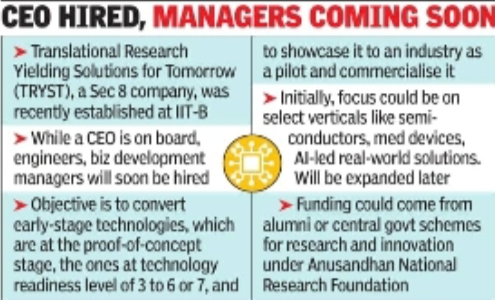
CEO hired, Managers coming soon
Explaining the concept, Prof Milind Atrey, deputy director (academics, research and translation), said, “Only about 1% of the campus population become entrepreneurs, and just a fraction of these start-ups survive beyond five years. Since most professors and students are not trained for entrepreneurship, many great ideas do not take off despite funding. But if a technology has real-world value, it shouldn’t remain unused at IIT Bombay.” The institute estimates that about 20-30% of their technologies hold potential for further development and industry adoption.TRYST was mentioned by director, Prof Shireesh Kedare, during the recently concluded Bharat Innovates Deep-Tech Pre-Summit, which focused on taking India’s translational research to the global stage. The initiative will function in two ways, first by translating existing laboratory technologies into industry-relevant products, and by developing solutions based on specific industry demands. In the second, companies can approach the centre with problem statements, which will be addressed using the institute’s technical expertise. TRYST’s professor-in-charge Chandra Sekher Yerramalli said, “If a technology is currently at a readiness level (TRL) of 3, we aim to advance it to levels 6 or 7, demonstrate a pilot to industry partners, and subsequently take it to the product stage for commercialisation.”Dr Jitendra Balakrishnan has been hired as TRYST CEO.Prof Atrey added, “Today, when industry collaborates with a professor, they end up handling everything, from timelines, hiring, and project management, leaving less time for core technical work. With TRYST, these responsibilities can be centralized, allowing faculty to focus purely on their expertise.”The institute recently invested Rs 200 crore in the Centre for Sophisticated Instruments and Facilities. TRYST will make use of this centre for development of technologies. The institute hopes to raise funds from alumni as well as govt under Research, Development and Innovation scheme.