

It’s no secret that diabetes can lead to brittle bones. But that better bone health can ensure improved blood sugar control is increasingly becoming evident in clinical settings. For decades, bones were seen only as a structural support system. “However, in recent years, medical science has revealed how bones play an active role in regulating metabolism and blood sugar levels,” says senior orthopaedic surgeon Dr Mir Jawad Zar Khan, MD and chairman at Germanten Hospitals, Hyderabad.One of Dr Khan’s patients, a 58-year-old male with long-standing Type 2 diabetes, had persistently high fasting blood sugar levels (180-200 mg/dL) despite regular medication. He was also found to have early osteoporosis. “We focused on improving bone metabolism through vitamin D and calcium supplements, improved nutrition, and regular weight-bearing exercise along with standard diabetes management. As his vitamin D levels and bone health improved, his fasting sugar dropped to 120-130 mg/dL over the next few months,” recalls Dr Khan.
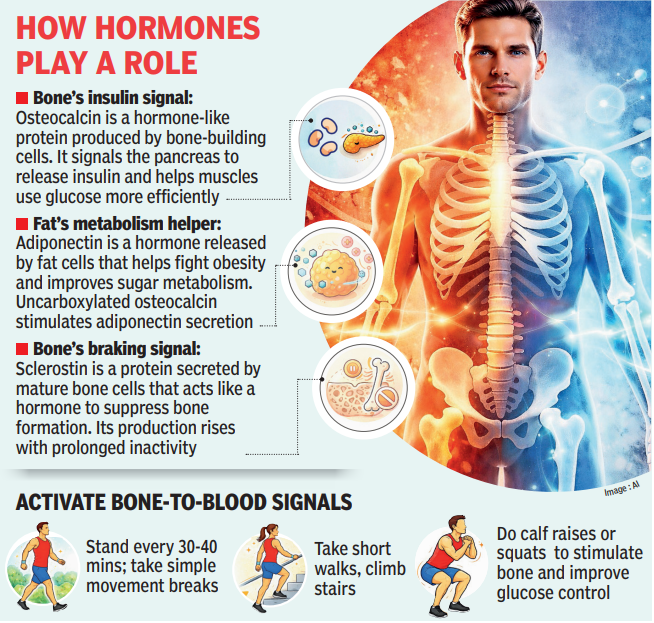
But how does it work? Dr Pradeep Mahajan, regenerative medicine researcher and founder of StemRx Hospital & Research, Navi Mumbai, explains that weight bearing exercises help activate bone-forming cells called osteoblasts, which in turn release a hormone-like protein called osteocalcin that is crucial for insulin sensitivity. “Osteocalcin does more than build bone. It signals the pancreas to release insulin and helps muscles use glucose more efficiently for energy.” The bone-pancreas-muscle feedback loop is the body’s internal communication system that links movement to metabolic health. “Exercise makes bones activate hormonal signals which improve how muscles handle sugar, creating a positive cycle that protects against diabetes and metabolic disorders,” adds Dr Mahajan.A 2021 paper out in Bone Research talks about the bone as an endocrine organ controlling energy balance and homeostasis. Just as bone tissue is affected by insulin, bone-derived hormones such as osteocalcin can also affect energy metabolism. “Diabetes and weak bones often coexist as high blood sugar reduces calcium absorption, weakens bone formation and raises fracture risk. Fragile bones impair metabolic regulation, creating a vicious cycle,” says Dr Khan.Calcium alone is not sufficient for bone health. Dr Sandeep Adke, orthopaedic surgeon and director, Adke Hospital & Russian Ilizarov Center, Solapur says vitamin D is crucial for intestinal calcium absorption and also regulates bone remodelling. “Then there’s vitamin K, which carboxylates (chemical reaction that inserts carbon dioxide into molecule) osteocalcin to bind calcium to the bone matrix. Protein provides structural framework (collagen), and magnesium, phosphorus, zinc, and copper are essential for bone and teeth formation as well as enzymatic regulation for metabolic efficacy.“In ‘Crosstalk between bone and other organs’, a 2022 article brought out by international academic publisher De Gruyter Brill, Chinese researchers highlighted that uncarboxylated osteocalcin doesn’t just boost insulin sensitivity, it also ramps up adiponectin, a hormone from fat cells that fights obesity and improves sugar metabolism. Studies link low osteocalcin levels in blood to higher risks of diabetes, obesity, insulin resistance, and metabolic syndrome. Mice models showed that in those without osteocalcin, the pancreas shrinks and they develop poor glucose tolerance, or prediabetes.Since exercise boosts osteocalcin release, adults should aim for at least 150 minutes of brisk walking, stair climbing, jogging, or dancing every week, along with 2-3 sessions of resistance exercises, says Dr Prashanth S, a hand surgeon from Pune’s PanOrtho Hospital. “Older adults benefit from balance and strength work to prevent falls. Higher impacts improve bone density, while moderate-intensity strength training strongly improves insulin sensitivity. Consistency matters more than intensity,” he says, adding that even if someone exercises daily, long sedentary periods can blunt metabolic benefits.Dr Adke points out that a sedentary lifestyle reduces new bone formation and increases bone resorption (breakdown), leading to lower bone density and increased fracture risk. “Inactive, unloaded bones, such as during prolonged bed rest or sitting, increases production of sclerostin, a protein that suppresses bone formation and promotes osteoclasts to break down old bone,” he says, adding that those with diabetes, pre-diabetes, osteoporosis, arthritis, or a history of fractures must focus on use of operated limb and exercise for better insulin regulation and improved joint mobility.