

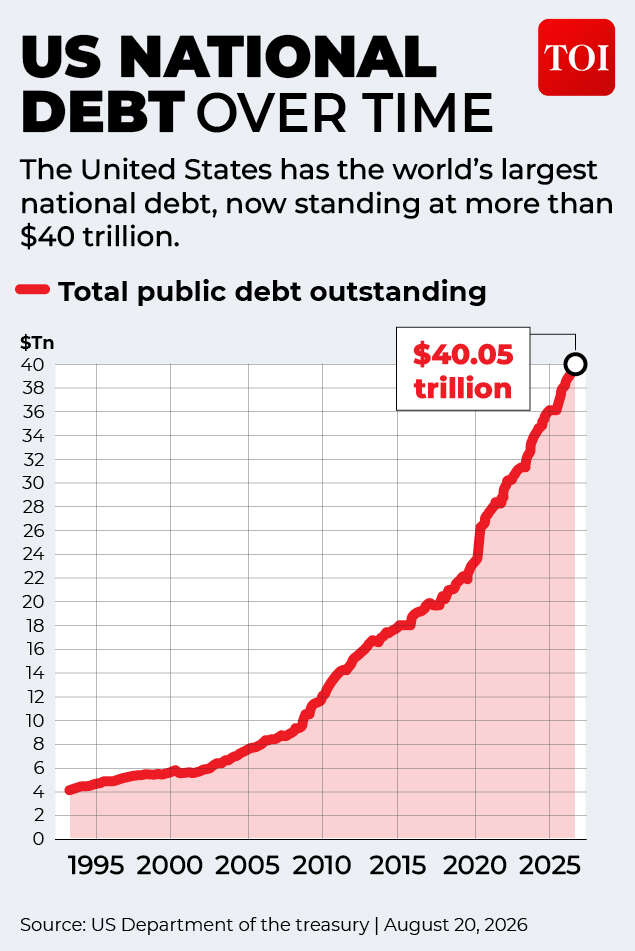
Forty trillion dollars. Written out in full, that is $40,000,000,000,000, a four followed by thirteen zeros.Spend a dollar every second, and it would take more than 1.2 million years to get through the whole amount. Or stack that same sum in $100 bills, one on top of the other, and the pile would reach around 27,000 miles into the sky, enough to wrap right around the Earth with room to spare.On 18 August 2026, the US Treasury confirmed that America’s national debt had crossed exactly that mark for the first time in history, months earlier than most forecasters expected just a year ago. That works out to roughly $117,000 for every American, or nearly $297,000 per household.Numbers this size stop meaning much after a while. But they raise one genuinely interesting question. Who does the world’s biggest economy owe to?
What is national debt, anyway?
Every year a government spends more than it collects in tax, the shortfall is called a deficit. Governments cover that gap by borrowing, mostly by selling Treasury bonds, bills and notes to investors. Add up enough years of deficits and you end up with a national debt.Think of it like a mortgage or a business loan. Borrowing money is not automatically reckless. What matters is what the money is spent on, and whether the economy grows quickly enough to make the borrowing worthwhile.
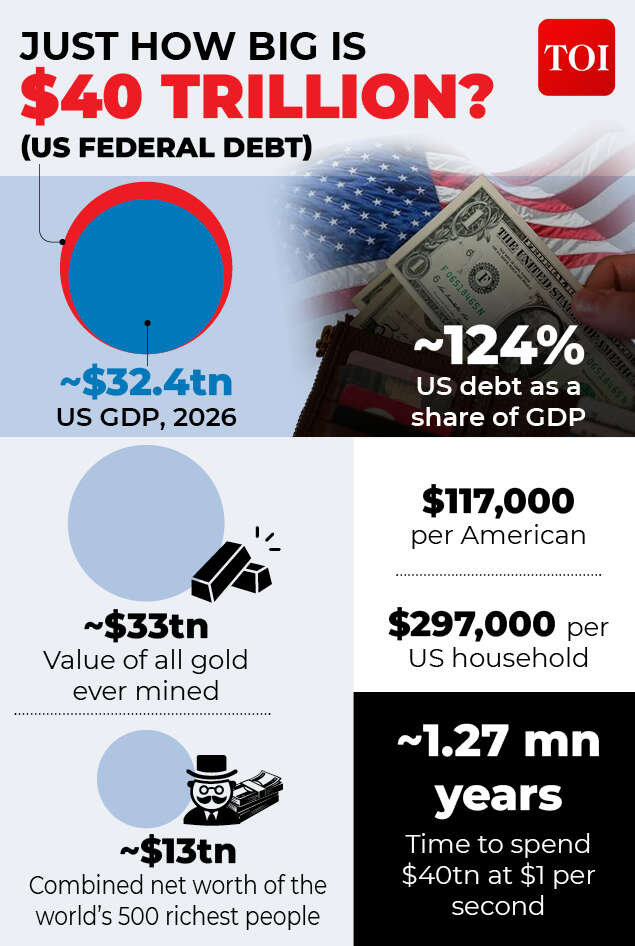
At around 124% of US GDP, the $40tn debt pile is larger than the entire annual economic output of the country.
Countries have used debt for centuries to fund wars, recover from crises, and build the infrastructure and technology that drive future growth. If the economy grows faster than the cost of borrowing, the debt becomes easier to carry over time. That is roughly what happened after the Second World War. Debt held by the public reached around 106% of GDP, then decades of strong postwar growth steadily brought the ratio down, without America ever needing to pay off the whole debt in one go.Japan shows just how much debt an advanced economy can carry without collapsing. Its debt-to-GDP ratio sits above 200%, the highest of any major economy, and has done for years. Most of that debt is held domestically and in yen, which shields Japan from the kind of panic that hits countries reliant on foreign lenders.America has a similar cushion. The dollar is the world’s dominant reserve currency, and US Treasuries are seen as one of the world’s safest assets, which keeps investors willing to lend Washington money.The real concern is not that America has debt. It is the maths behind it. Interest rates have climbed sharply since 2022, and the cost of servicing the debt is now rising faster than the economy itself, a very different picture to the cheap-borrowing years of the 2010s.
So who does Uncle Sam actually owe?
This is where the $40tn figure gets interesting.Start with the $7.78tn in intragovernmental debt, roughly a fifth of the total. Think of it as the government moving money from one of its own pockets to another. The largest holder is the Social Security Trust Fund, which holds around $2.3tn. When payroll taxes bring in more than the programme pays out in benefits, the surplus is invested in special Treasury securities, essentially one arm of government holding an IOU from another.The remaining $32.27tn is debt held by the public, and this is where the “who does America owe” question really begins.
At around 124% of US GDP, the $40tn debt pile is larger than the entire annual economic output of the country.
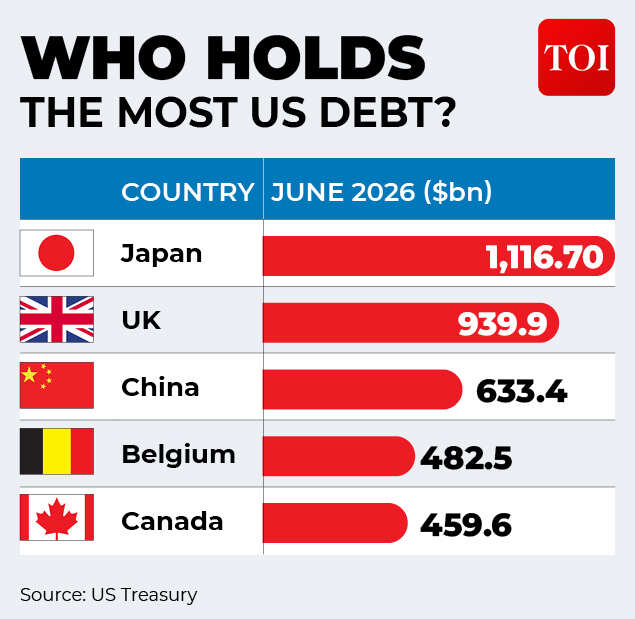
The biggest slice belongs to domestic private investors. American mutual funds, banks, insurers, pension funds and households collectively hold around $17.9tn, or roughly 57% of publicly held debt. If you have a pension or an index fund with any bond exposure, there is a decent chance you are quietly one of Uncle Sam’s creditors yourself.The Federal Reserve holds a further $4.4-4.5tn through its own bond portfolio, close to 14%.Foreign investors hold around $9.35tn, roughly 29% of publicly held debt, and less than a quarter of the full $40tn once intragovernmental debt is included.Here the popular image usually gets it wrong. China is not the biggest foreign holder, and has not been for years. That title belongs to Japan, a close US ally, which holds around $1.21tn. The UK comes second at roughly $937bn. China sits third at around $651bn, having steadily cut its exposure from a 2013 peak of $1.32tn as Beijing diversifies its reserves. Further down the list sit Belgium, the Cayman Islands, Luxembourg and Ireland, all financial centres, so their large holdings often belong to investors based elsewhere entirely, simply routed through custodians there.The US Treasury does not owe these countries one giant loan. It owes millions of investors through a constantly rolling market of Treasury securities. Even Japan’s $1.21tn holding is nowhere near enough to dictate America’s borrowing costs on its own.Add it up and roughly four-fifths of America’s $40tn is owed to Americans, American institutions or the government itself.The popular image of America being indebted to the rest of the world is therefore misleading. Uncle Sam’s debt is overwhelmingly homegrown.
Trump’s debt bill so far
Since Trump returned to office in January 2025, the debt has grown by around $3.8tn in about nineteen months. Combined with the $7.8tn added in his first term, his two terms have so far added roughly $11.6tn. For comparison, the debt grew by about $8.4tn across Joe Biden’s four years, from roughly $27.8tn to $36.2tn, so the current pace is running noticeably faster.
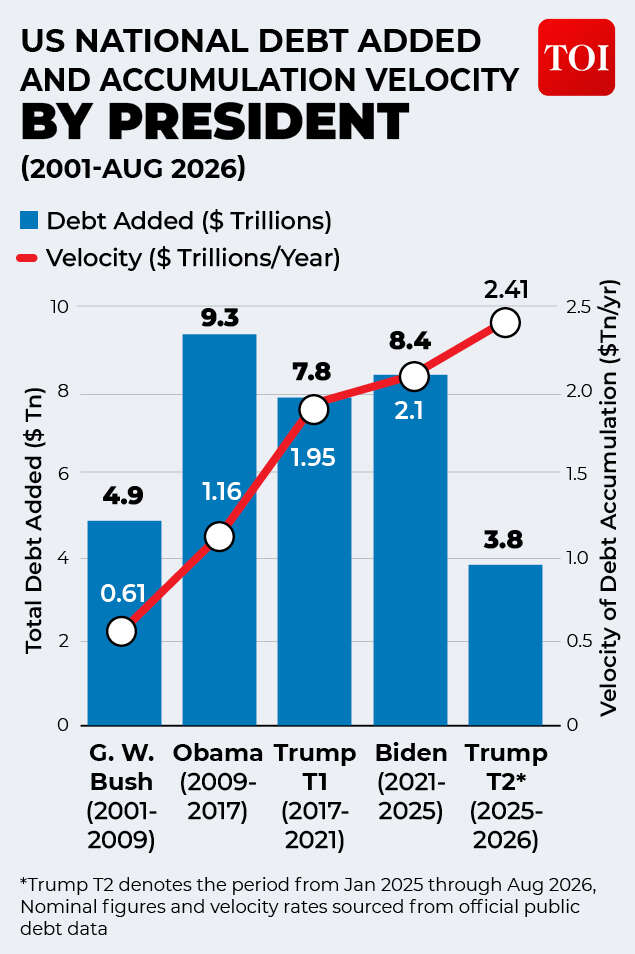
Trump’s second-term debt accumulation is already moving faster than during his first term
A large chunk of the recent rise came from the One Big Beautiful Bill Act, the tax and spending package Trump signed into law in July 2025, which the Congressional Budget Office estimates will add around $4tn to the deficit over the next decade, largely through extended tax cuts. Rising defence spending, including the cost of this year’s war with Iran, has added further pressure, alongside the lost tariff revenue outlined earlier.But the debt problem does not belong to one president. The US has run persistent deficits under both parties for decades, through tax cuts, wars, recessions and emergency spending. The $40tn figure is simply the accumulated bill.
The bond market’s verdict
The $40tn figure tells us how much America owes. The bond market helps determine how much it costs to keep owing it.Think of the US government as someone with a giant mortgage that never quite gets paid off. Every time part of that mortgage comes due, it borrows again to pay it off. As long as lenders are happy to keep offering roughly the same interest rate, the arrangement can continue without too much trouble.The problem starts when those lenders ask for more.That is essentially what Treasury yields tell us. A Treasury yield is the interest rate investors demand to lend money to the US government. When yields rise, Washington has to pay more to borrow. And because the US has to keep refinancing huge amounts of existing debt while borrowing more to cover its deficit, even a small increase in rates can eventually add billions to the government’s interest bill.
The pace of borrowing has changed dramatically: the latest $1tn was added in less than five months, compared with 205 years for the first.
That is why the bond market matters to the $40tn story.On the day the debt crossed $40tn, Treasury Secretary Scott Bessent announced plans to at least double some long-term Treasury buyback operations, from $2bn to at least $4bn per operation. The move came as a bond sell-off pushed the 30-year Treasury yield as high as 5.34%, its highest level since 2007.The announcement briefly pushed yields lower before they drifted back up within a day. That is because a buyback can help manage the supply of bonds in the market, but it does not fix the underlying deficit. It is more like rearranging the mortgage than reducing the amount you owe.The reason investors are jumpy is in the numbers. The federal deficit is running at around 5.8% of GDP, well above the 3.8% average of the past 50 years. Interest costs alone eat up about 3.3% of GDP and are now one of the fastest-growing items in the federal budget.The risk is a feedback loop. If borrowing costs stay above the pace at which the economy grows, the debt becomes harder to stabilise. Rising interest costs can then require more borrowing, putting further pressure on rates.
The bill keeps coming
America’s first trillion dollars of debt took 205 years to accumulate, arriving in October 1981. The most recent trillion, the climb from $39tn to $40tn, took under five months. Ten trillion came in 2008, twenty trillion in 2017, thirty trillion in 2022, and now forty trillion in 2026, each milestone arriving faster than the last.None of that means the sky is falling. America can still borrow in its own currency, and investors around the world still buy its debt when markets turn nervous. What has changed is the price of that comfort.The $40tn figure is not a crisis on its own. It is the accumulated bill for decades of tax cuts, wars, recessions and political promises made by presidents and Congresses of both parties.The US can keep rolling the debt over. But the interest bill keeps coming due.