
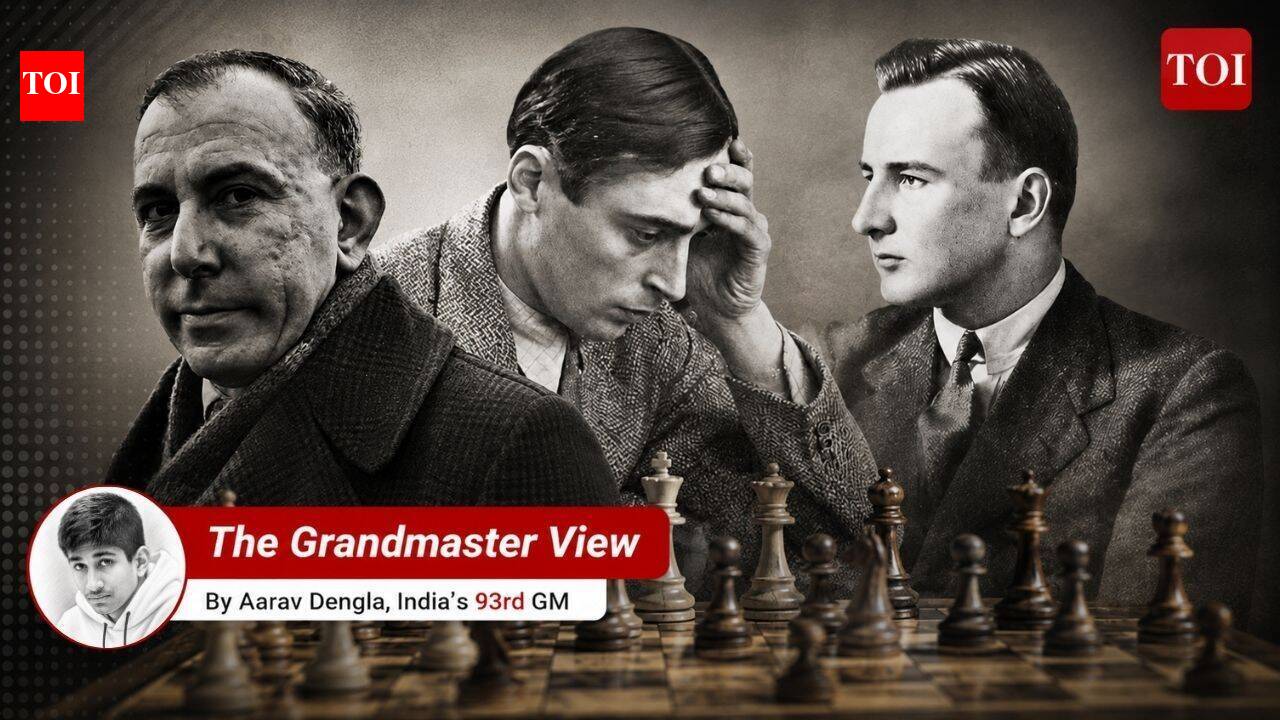
On September 1, 1939, Germany invaded Poland. On the other side of the ocean, the final stage of the 1939 Chess Olympiad was getting underway in Buenos Aires.It was the first Olympiad to be organized outside Europe and was the largest to date, with twenty-seven national teams participating. England had sent five players: Hugh Alexander (the reigning British champion), Sir George Thomas, Stuart Milner-Barry, Harry Golombek, and Baruch Wood. England finished third in its preliminary group and qualified for the championship final.The unfolding events in Europe followed the players into the tournament hall. Britain declared war on Germany on September 3. England withdrew from the competition and returned home, while all other teams continued. Germany eventually won the Olympiad, finishing half a point ahead of Poland.For three members of the English team, the return journey led to work that would not be discussed publicly for decades. Alexander, Milner-Barry, and Golombek joined the Government Code and Cypher School at Bletchley Park. Britain had assembled a team of elite chess players, mathematicians, linguists, engineers, intelligence analysts, machine operators, and many others at Bletchley Park to break the Enigma code used for encrypted communications by the German armed forces.The presence of three leading chess players in a top-security, highly classified codebreaking organization did not mean that chess players were inherently good at cryptanalysis. Codebreaking was a team effort relying on skilled individuals drawn from multiple fields. However, the skills the trio had honed on the chessboard — concentration, narrowing down alternatives, pattern recognition, and endless patience when no solution was immediately visible — proved supremely helpful in their roles at Bletchley.Alexander arrived at Bletchley Park in February 1940. He began in Hut 6, which worked on codes used by the German Army and Luftwaffe. In March 1941, he moved to Hut 8, the section solving codes used by the German Navy. There, he became Alan Turing’s deputy and later acting head. When Turing traveled to the United States in November 1942, Alexander took over the section. Hut 8’s task was particularly crucial during the Battle of the Atlantic, where German U-boats threatened Allied supply convoys. Decrypting German naval signals helped locate U-boats and prevent attacks on Allied ships.Milner-Barry worked in Hut 6, leading a group that searched for “cribs” — pieces of plaintext that might appear in an encrypted message. A crib did not reveal the encryption settings on its own, but it provided a hypothesis that could be tested using specialized codebreaking machines. In March 1943, Milner-Barry became head of Hut 6.Golombek worked for a period in Hut 8 on naval Enigma before moving to another section late in 1942.Enigma was difficult to crack because it used a vast array of possible configurations that were changed regularly. Success in breaking a code and reading traffic on one day could evaporate with the next setting change. Human judgment was needed to narrow down the possibilities using evidence such as captured material, knowledge of German procedures, repeated phrases, operator mistakes, and the mathematical properties of the machine itself. That narrow set of possibilities was then tested using machines.Parallels between how human codebreakers worked and how elite chess players compete are hard to miss. It is impossible to calculate every possible move on the board; experienced players spot a small number of plausible moves and examine them deeply. At Bletchley, codebreakers similarly had to decide where to direct their limited time and machinery.The chess trio did not break Enigma on their own. The code had already been attacked successfully by Polish cryptanalysts before the war, and the British effort built on those Polish discoveries. At Bletchley Park, thousands of people contributed to the interception, analysis, processing, and distribution of intelligence.After the war, the trio folded back into ordinary life. Golombek returned to chess as a writer and arbiter, while Milner-Barry joined the Treasury. Alexander stayed in the secret world and rose to lead codebreaking at GCHQ, the British agency tasked with signals intelligence. For decades, they were not allowed to talk about their work at Bletchley; it remained classified, and the men who had accomplished it went uncredited by design.Catch up on Aarav Dengla’s previous columns: Click hereIn September 1939, five Englishmen abandoned a tournament in Buenos Aires and sailed home, leaving the trophy to be won by Germany. Over the ensuing six years, members of this team played in a different arena with far higher stakes and no rules of fair play. They did not win the tournament in 1939, but they did their part in winning the most consequential war of their lives.(Aarav Dengla is India’s 93rd Grandmaster. He is a keen observer and student of world history in general and chess history in particular.)