

The US Senate on Friday passed the Lindsey O. Graham Sanctioning Russia and Iran Act of 2026, a sweeping bipartisan sanctions package aimed at tightening economic pressure on Moscow and Tehran while targeting countries that continue to finance Russia’s war effort through energy purchases.Read more: 100% tariffs: Why India may ignore Trump threat and continue buying Russian crude oilNamed in honour of the late Republican Senator Lindsey Graham, one of the legislation’s principal architects, the bill authorises the US president to impose punitive tariffs and sanctions on countries that continue importing significant volumes of Russian oil and gas.
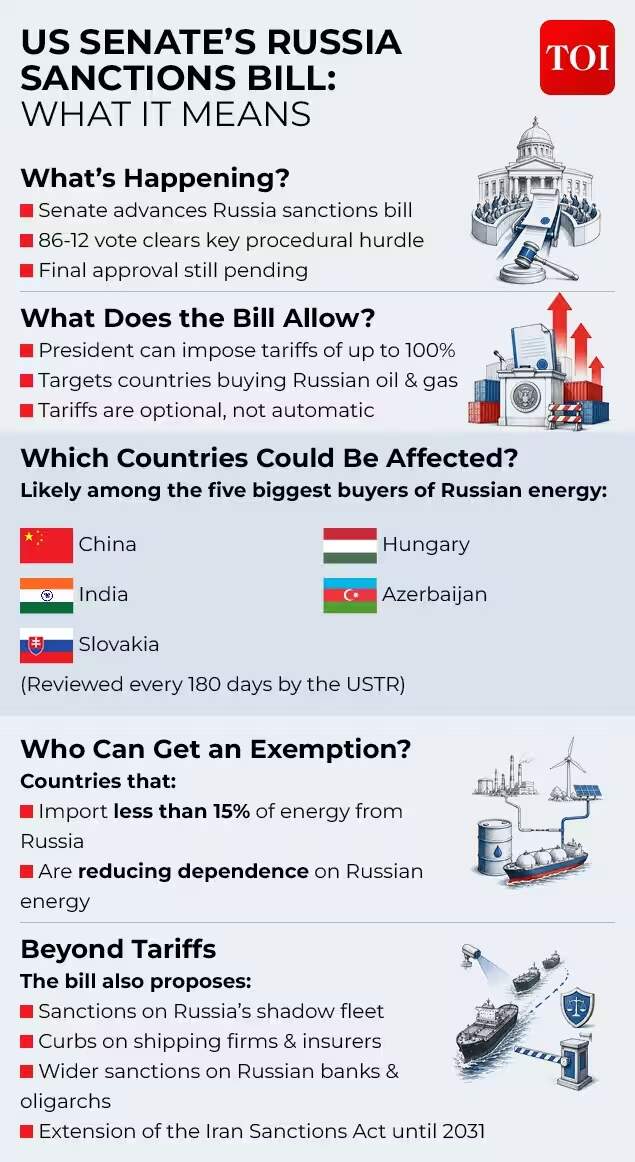
US Senate’s Russia Sanctions Bill: What it means
The measure now heads to the House of Representatives before it can be sent to the White House for the president’s signature.The legislation marks a softer approach than earlier proposals that called for tariffs of up to 500% on imports from countries buying Russian energy.The final Senate version lowers the maximum tariff to 100% and gives the US president broad discretion to waive, delay or modify the penalties if doing so is deemed to be in the national interest.
What it means for India
For India, the bill carries potentially significant implications.Since the outbreak of the Russia-Ukraine war in 2022, India has emerged as one of the world’s largest buyers of discounted Russian crude, helping Moscow maintain oil revenues despite Western sanctions.Russian oil now accounts for a substantial share of India’s crude imports, making New Delhi one of the countries most closely watched under the proposed law.However, India would not automatically face tariffs if the legislation becomes law.The bill grants the US administration considerable flexibility over whether and how to enforce the measures.Analysts say any decision would likely take into account the broader strategic partnership between Washington and New Delhi, including cooperation in the Indo-Pacific, defence, technology and efforts to counter China’s growing influence.Even so, the legislation introduces a fresh element of uncertainty into India-US trade ties.If tariffs were imposed, they could affect billions of dollars worth of Indian exports to the US, including engineering goods, pharmaceuticals, chemicals, textiles and auto components. The prospect of such measures could also increase diplomatic pressure on New Delhi to gradually diversify its energy imports away from Russia.The bill also expands sanctions targeting Iran’s energy, shipping and financial sectors, reflecting Washington’s effort to simultaneously squeeze two of its principal geopolitical adversaries.Supporters argue the legislation will further restrict the revenue streams funding Russia’s military campaign in Ukraine and Iran’s regional activities, while critics have warned that secondary sanctions on major economies such as India and China could strain US relations with key partners and disrupt global energy markets.