
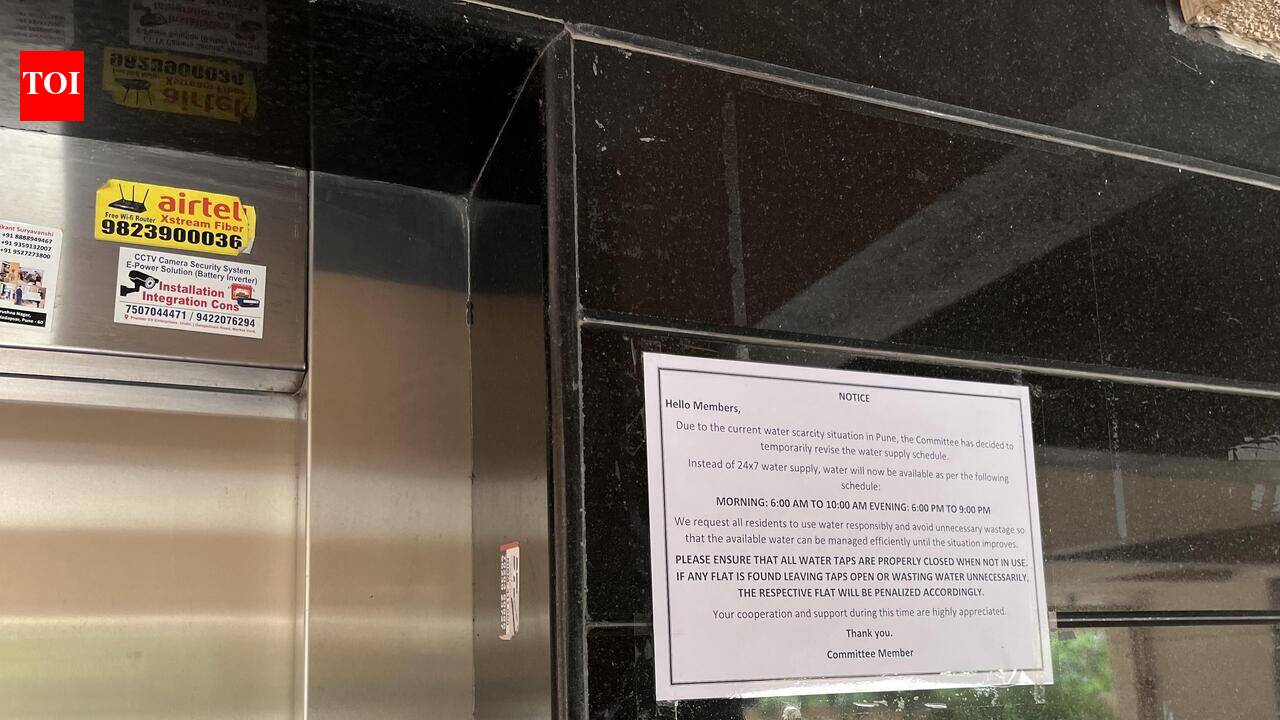
Pune: The civic body’s alternate-day water supply schedule, introduced due to depleting water reserves and delayed rainfall, has forced residents to alter their routines and adopt strict conservation measures.From collecting wastewater from RO (reverse osmosis) filters for cleaning and dishwashing to storing water in every possible container, including washing machines, residents are scrambling to cope with the Pune Municipal Corporation’s (PMC) alternate-day water supply amid a worsening water crisis.Sunil Koloti, a resident of Nyati Windchimes in Undri, said water conservation has become part of daily life. His family reuses reject water from their RO system for household chores.“Our society is entirely dependent on tankers. We need around 15 tankers a day but are getting only eight to 10. The pressure has increased because we are not connected to the PMC water supply network,” Koloti told TOI.Many housing societies have issued advisories urging residents to reduce water consumption, making daily life increasingly difficult.Neepa D, a resident of Imperial Towers on NIBM Road Annexe, said her family has been storing water wherever possible.“Our society receives PMC water, and we never had to worry about shortages earlier. This time, it is different. Even on supply days, water comes only for three hours in the morning and three hours in the evening. Sometimes there is water in the kitchen but not in the bathrooms. Storing water and finding ways to use it carefully has become the only option, but it is stressful,” she said.A homemaker from the same area said the crisis has completely changed her routine.“Water comes for a few hours in the evening, and I try to finish most of my cooking then. In the morning, supply starts around 5am, so I wake up early to cook lunch and store water at the same time. With schools reopening, managing everything has become extremely stressful,” she said, requesting anonymity.Residents in tanker-dependent areas say the situation is even worse.Kishor Baligar, secretary of Dorabjee Paradise Bungalow Society, said many households have been forced to cut back on basic activities.“Despite the heat, many residents are not showering daily. Vehicle washing has stopped completely. Earlier, we used to receive one PMC tanker every day; now it comes once every four or five days. We require at least seven private tankers daily, but operators claim they are unable to source enough water. Washing clothes in machines and watering plants have become rare,” he said.Sanjiv Patil, director of the Wagholi Housing Societies Association, said tanker operators have increased rates from Rs 800 to Rs 1,000 per tanker.“Wagholi is among the worst-affected areas. Nearly 400 housing societies here depend entirely on tankers. The increase in tanker charges has added to residents’ distress. We are reusing RO reject water for cleaning and have installed aerators on taps to reduce consumption,” he said.For Ramesh Kaapte, a Yerawada resident who works night shifts at a call centre, the crisis has also affected his sleep.“Storing water has become a daily hassle and usually has to be done in the morning. We have PMC water, but the supply is irregular despite the alternate-day schedule. My wife looks after our two infants, and I constantly worry about ensuring there is enough water at home. Even after night duty, I can’t sleep peacefully because water is always on my mind. Constantly lifting heavy buckets has aggravated my back pain,” he said.