

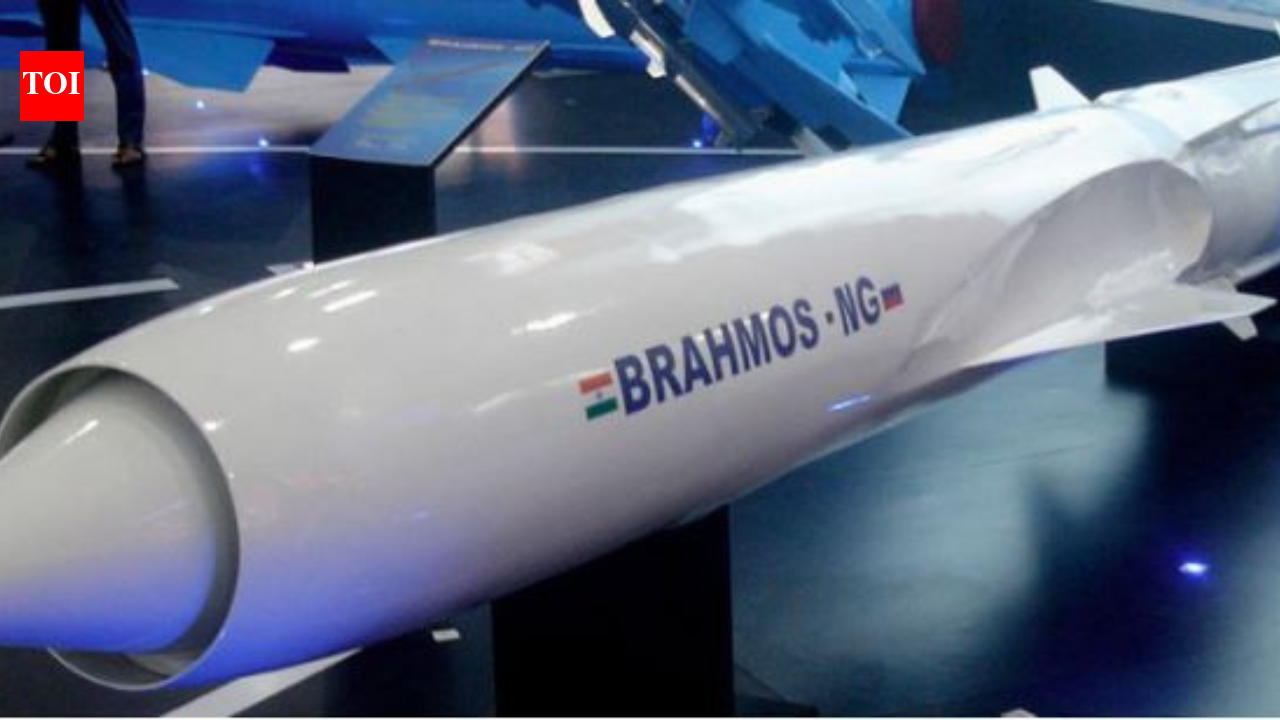
NEW DELHI: India and Russia are “jointly developing small and hypersonic variants of BrahMos supersonic cruise missile that will further enhance the multi-domain strike capabilities of the Indian armed forces”, Russian ambassador to India Denis Alipov has said, as quoted by Russian state-funded media RT India.He said this while India and Russia marked 25 years since the first test-launch of the jointly developed BrahMos was conducted on June 12, 2001, from the Chandipur test range in Odisha.According to a video on RT India’s X account, “India and Russia are working on a 800-km strike version of a BrahMos, a submarine-launched variant of BrahMoS under the P75I programme; a miniaturised lighter version of BrahMoS for integration with aircraft and a hypersonic BrahMos missile.”With the existing BrahMos cruise missile weighs nearly 3 tonnes and has 2.8 Mach speed, the BrahMos Aerospace, an Indo-Russia joint venture, in collaboration with Defence Research and Development Organisation (DRDO), is already working on BrahMos-NG (Next-Generation), which is a smaller, lighter and stealthier variant of the standard missile. Once developed, the miniaturised BrahMos-NG will weigh 1.2 tonnes, will have Mach 5 speed and can be easily fitted on a wider array of platforms, including LCA Tejas and Su-30MKI fighter jets.While flagging off the 100th indigenous booster for the BrahMos missile manufactured at Solar Industries’ facility in Nagpur, BrahMos Aerospace chief Jaiteerth Joshi said on Thursday, “Future developments include work on BrahMos-NG and very long range variants, with research also focused on lighter designs using composite materials. Final specifications will be determined after design validation and simulation studies are completed,” he said. Joshi said newer versions will reduce costs by around 20% (one standard BrahMos costs around Rs 34-35 crore) and also increase indigenous content in the missile system. Joshi also said, “Solar Industries has also done warhead trials and we will be going ahead with the trials in near future and once it is successful, we will implement and replace the thing with the indigenous warhead.”A smaller BrahMos missile can be carried by more aircraft, ships and future unmanned platforms, while a hypersonic version can reduce enemy reaction time.“The miniaturised variant (BrahMos NG) will feature a smaller radar cross-section than its predecessor and will have an active electronically scanned array (AESA) radar seeker for heightened precision,” a source in DRDO told TOI. “Five such BrahMos NGs can be carried by a Sukhoi fighter, eight missiles by a land-based launcher and unlimited missiles by a warship,” the source said, adding, “the cost-effective BrahMoS-NG will have the technology of 2020-30s as compared to the 1990 technology in the existing BrahMos.”