
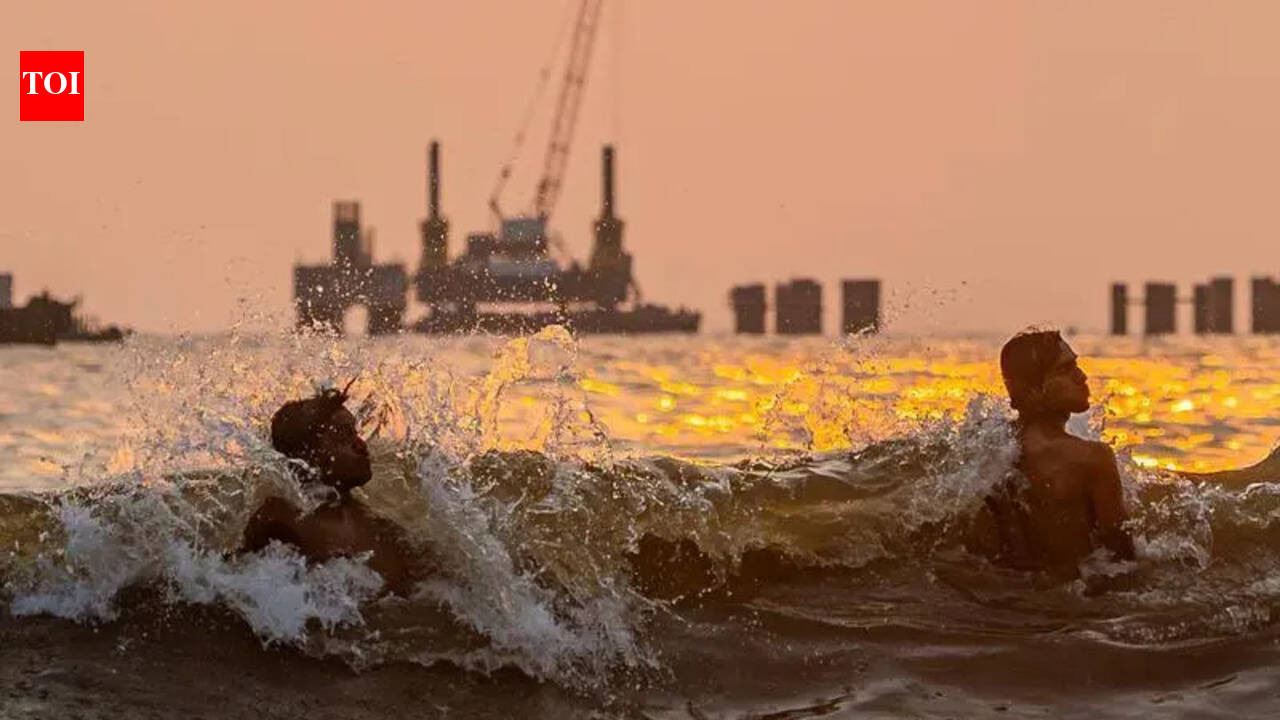
Mumbai: While large parts of Maharashtra continue to reel under an intense heatwave — with Nagpur touching 45 degree Celsius and Akola and Amravati nearing a blistering 47°C, Mumbai has remained relatively cooler. The city recorded maximum temperatures of 34.5°C at Colaba and 34.3°C at Santacruz on Monday. But the relief is deceptive.Weather experts say a steady westerly wind pattern has prevented temperatures from soaring, even as it brings in moisture from the Arabian Sea. The result: humidity levels hovering between 60% and 70%, significantly pushing up the heat index, or the “feels like” temperature — especially when the mercury crosses 35°C. Relative humidity recorded on Monday by IMD Colaba and Santacruz was around 76%, respectively.This spike in perceived heat is now driving daytime discomfort across the city, with residents reporting sticky weather conditions despite moderate readings.“Humidity is the real culprit right now. It traps heat and prevents the body from cooling efficiently, making conditions feel far hotter than actual temperatures,” said independent weather forecaster Athreya Shetty.Adding to the discomfort is Mumbai’s changing urban landscape. Experts point out that lesser green cover than before and the rise of concrete and glass-heavy infrastructure are creating localised “heat pockets”. These areas absorb heat through the day and release it slowly at night, keeping minimum temperatures elevated and nights unusually warm. “Green cover can reduce local temperatures by up to 6-10°C, but high-rises and dense construction restrict airflow and trap heat, worsening the urban heat island effect,” Shetty added. Humidity levels tend to rise towards the end of April. However, it is the increasingly warm and muggy nights that are intensifying the sense of heat in Mumbai.The city’s coastal geography continues to play a moderating role. Sea breeze influences — particularly in south Mumbai and the western suburbs — help keep daytime temperatures in check, said another independent forecaster, Abhijit Modak, adding, “It’s important to note that what Mumbai is experiencing right now is fairly typical for this time of year — there’s nothing unusually alarming about it. As a coastal city, especially in south Mumbai and the western suburbs, temperatures are moderated by sea breeze patterns that set in during April. In contrast, March tends to be hotter for the city due to dry northeasterly winds, which is why temperatures touched around 40°C last month.” Last month, on March 10, Mumbai recorded a scorching 40°C — nearly 7.6°C above normal — qualifying as a severe heatwave.Experts, though, said unlike Mumbai, which is recording temperatures around 33-35°C, this moderating effect is absent in most parts of interior Maharashtra, where dry northerly and northwesterly winds from desert regions such as Gujarat and Rajasthan push temperatures well beyond 41-45°C, particularly in cities such as Nagpur, Pune and Nashik.Even within the Mumbai Metropolitan Region, there are sharp microclimatic variations depending on the distance from the coast.Thane and Navi Mumbai have seen 41-42°C, Dombivli to Badlapur around 43°C, and Karjat has touched 45°C — comparable to Vidarbha conditions — all as per private automatic weather stations, said Modak, adding the heat one experiences in the MMR depends heavily on location.“In the Konkan belt, the timing and strength of the sea breeze also influence the ‘feels-like’ temperature, as humidity plays a significant role. Unlike interior Maharashtra, where dry heat dominates, coastal regions like Mumbai experience a mix of heat and humidity, which can often feel more intense,” said Modak.