

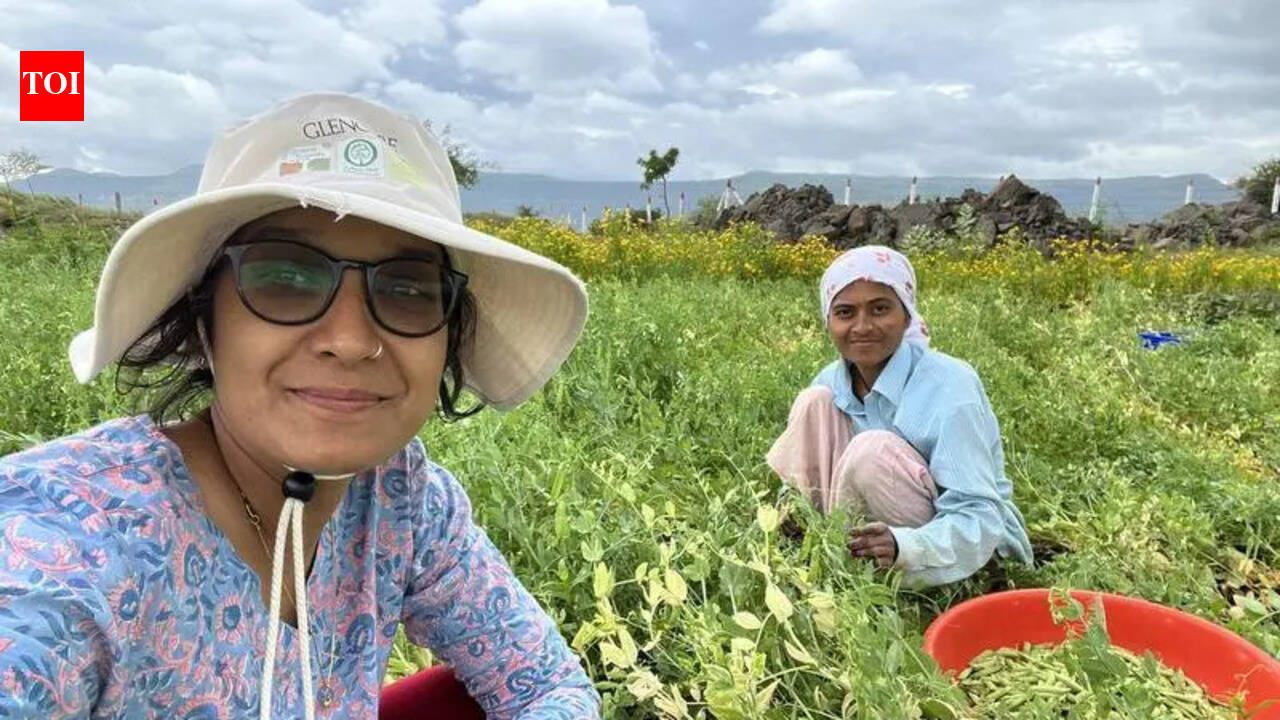
Pune: The transition into agricultural pursuits for 41-year-old Aundh resident Smita Mehetre didn’t start with sprawling acres of fertile land. It began over a decade ago on a humble one-metre-by-10-inches windowsill, with just a few tiny plants.Today, she owns and operates a thriving organic farm in Satara, but her core message to urban dwellers remains unchanged: “You don’t need a farm to start growing food.” Mehetre’s inspiration was sparked in the dull, grey climes of the UK. When she moved there after her wedding, gloomy skies and persistent rain were constant, viewed from a house with no balcony or backyard and barely any direct sunlight. But the young woman could not ignore her green thumb. She told TOI, “I have always felt my mood uplift when I’m closer to greenery. I wasn’t sure if any edible plants would grow on the windowsill, my only available space. I gave it a try in 2012 and bought saplings of tomato, basil and coriander. That’s how my journey started — small, with a few houseplants and herbs. I nurtured the little basil plant and made countless jars of comforting pesto. The day the first cherry tomato ripened sparked something deep within me. It showed me I could grow food, even in a tiny flat with limited light. There was no looking back.” Over the next nine years, Mehetre’s micro-farming enthusiasm flourished, moving her mini-garden to each rented home. “I chose easy-to-grow plants, which I could include in my cooking. My grandfather and uncle farmed, so I had a basic idea of processes. But I also started watching YouTube videos and later signed up for an online course,” she said.Just before the Covid lockdown, back in India, Mehetre and a friend started growing papaya, moringa, yams and more on an empty bungalow plot. As her resolve to pursue this path strengthened, she began searching for farmland. In Feb 2022, she locked in on a three-acre plot in Kavthe village of Khandala tehsil in Satara. “When I started, nobody in the village took me seriously as a woman taking charge of the land. It took some time, but we all learnt from each other. Now, nobody questions me. They proactively help me,” she laughed. Mehetre said barriers to entry for growing plants are often more mental than physical. “You can begin right where you are, with a balcony, sunny window, or a few grow bags on a terrace. With each pot of spinach or tulsi, you take one step toward reclaiming your health and reconnecting with the food you eat,” she said. For her, this journey is about more than just gardening — it is a response to the industrialisation of our food systems. In an era where marketed “fresh” produce often travels thousands of miles and is treated with a cocktail of synthetic agents, growing your own food becomes a radical act, she said. She strongly believes in zero chemical use, instead relying on cow manure, ‘jeevamrut’ and seaweed, aside from smartly applying cropping patterns. Mehetre said, “I started selling coriander in 2022, my first year of full-scale farming and got an overwhelming response — it was sold out.” According to her, “cut and come again” greens are perfect for beginners, including spinach, coriander, and fenugreek (methi). They grow quickly and can be harvested multiple times. Another key trick, she said, is to prioritize sunlight. Most vegetables need at least four to six hours of direct sunlight, so one must find a ‘sweet spot’ in their home. Mehetre also recommended a thrifty outlook. “Upcycle containers. You don’t need expensive ceramic pots. Old paint buckets, tin cans, or wooden crates work perfectly with drainage holes. If you compost your scraps, you can turn kitchen waste into ‘black gold’. A small home composter provides all the nutrients your plants need without any chemical fertilizer.” Today, on her ‘Purna’ farm, Mehetre grows grains, lentils, greens, beans like rajma and peas, fruit like guava, banana, mulberries, etc., as well as oil seeds, herbs, root vegetables, and rosella, from which she makes fresh jams and syrups. “I grow mainly to secure my food through the year. Selling is a second priority,” she said. While she gets produce from her farm, Mehetre still nurtures her kitchen garden in Pune, where she stays. Puneites, she said, have had a weather advantage that lets them grow a variety of leafies, root veggies, beans, gourds, salad leaves, and strawberries. The once-amateur farmer envisions a world where the concrete jungle is softened by edible greenery, a “food forest” model wherein even high-rise apartments bridge the gap between nature and the modern consumer. “Let’s create a future where coriander grows in tin cans, tomatoes hang off grills, and kids pluck their own snack from a plant,” she said. After all, we all have the power to plant a seed.