
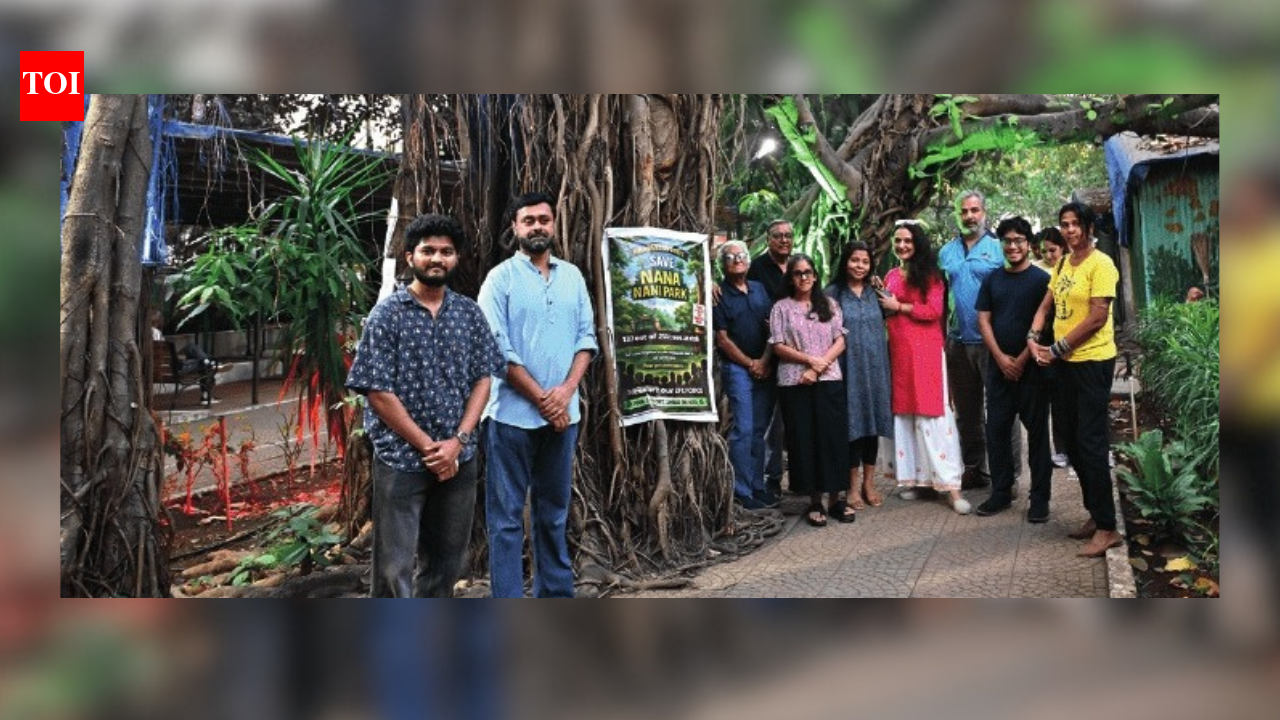
MUMBAI: A shadow hangs over the Nani Nani Park in Versova, cast not by its leafy canopy but by an impending concrete one. Earlier this month, regulars found notices attached to a scattering of trunks, each bearing a string of alphanumeric codes. It was a roll call of trees marked for felling or transplanting, compiled by the Tree Authority. They are to be replaced by other columns: concrete pillars for an exit road leading off the proposed Versova–Bhayander Coastal Road. More than half the park’s green cover—137 of 250 trees—are slated to be felled for the project.“It’s an ecocide,” fumes Nandita Puri, former journalist and wife of the late Om Puri. In the late ’90s, the Puris supported a citizen-led campaign to reclaim Versova Beach from encroachers. The Save Versova Beach Association, born of that effort, went on to create and improve other public spaces in the area, including the Nana Nani Park, which opened in 2001. “It was the first such park in the suburbs and the second in Mumbai,” says Harinder Bhasin, chairman of the Save Versova Beach Association, “Former state cultural minister Pramod Navalkar, who created the first Nana Nani Park in Girgaum Chowpatty, helped set this up too.”It took a sustained community campaign to transform a strip of debris and encroachments into a green oasis. Around 400 people use the park daily, according to the Save Versova Beach Association, while a laughter club and karaoke club convene weekly. “Some of the singers are quite besura,” says Puri, “But it’s still music to our ears.”The park is unusual in both form and setting—a green strip, 530-metres long and 40 metres wide, that runs like a median along Rayal Savid Link Road, commonly known as Versova Link Road. Seniors and young adults circle the walking track or sit around, shooting the breeze. Some use the public gym, while children scale the jungle gym.Contrary to its name, it’s a park for all ages, but many fear its time is now short. The proposed off-ramp will not only fragment the park with its pillars but cast a shadow over what remains with its overhead carriageway. How will plants survive with diminished access to sunlight, the community asks. Some worry that, eventually, the park will have to make way for the road.The park is a place of respite for local residents, while the exit ramp will only serve people passing through, notes Gauran Mehta, secretary of the association. “The road will deny locals their right to a clean environment and destroy an existing ecosystem,” he says, “We talk of pollution levels rising and then create conditions that increase pollution.”On March 9, at a public hearing in the K-West ward office, locals presented their opposition. Among the concerns was the Tree Authority’s claim that none of the park’s trees are over 50 years old—a classification that would qualify them as ‘heritage’ trees with added legal safeguards. Residents say roughly 30–35 trees are older than 50 years, including a banyan that is marked for the axe.They also proposed an alternative alignment: a 2 km northward extension of the sea link, in which the interchange exits onto JP Road via Shivpujan Sitapati Niwas Road. The route minimises impact on the mangroves and avoids the park.“What made this park unique was that it was born of a purely citizen initiative. But things have since changed in Mumbai,” observes Mehta, wryly, “We’re no longer citizens, but subjects.”