
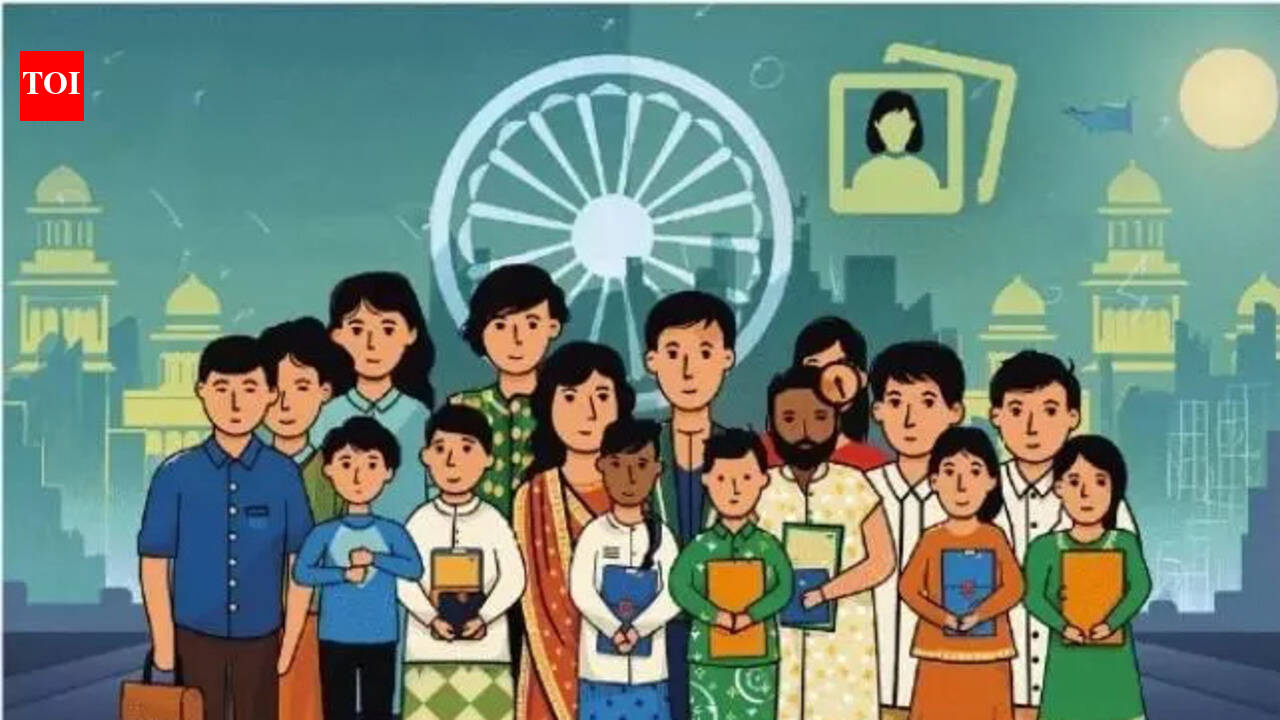
Pune: Amid a growing global community of adoptees revisiting their pasts, 32 inter-country adoptees filed applications with the Central Adoption Resource Agency (Cara) in 2024–25 seeking to trace their biological parents, TOI has learnt through an RTI response. For a growing number of adults adopted abroad from India, that empty space has become impossible to ignore. Many of them — now in their 30s, 40s and 50s — are returning to the country of their birth in search of answers their documents never held.These adoptees were part of hundreds sent abroad when India’s adoption landscape was a patchwork of private shelters, under-regulated agencies and inconsistent documentation. For them, the search is not only about identity — it is also about confronting the silence built into their early histories.A STUDY REOPENS WHAT WAS LONG BURIEDIn Feb last year, a study, titled ‘Mother Unknown’, cast new light on the scale and complexity of inter-country adoptions between India and Switzerland. Its findings: 2,278 Indian children were adopted into Swiss families from 1973 to 2002. The research team — anthropologist Rita Kesselring, ethnologist Andrea Abraham, historian Sabine Bitter, and Mumbai-based social worker Asha Narayan Iyer — examined 48 adoption files.What they found missing was more revealing than what remained. Not one file contained a deed of surrender, the document that confirms a birth mother’s informed consent. Across Swiss public and private archives, these papers had simply disappeared — or perhaps never existed in the first place. In many files, the same chilling phrase repeated itself: “mother unknown” — two words that would go on to shape entire lives.The study elaborates on how birth mothers “were erased from documentation and also from public consciousness”. Abraham says: “There is no discourse on the mother/parent’s perspective in India. It’s as if the birth mother did not exist. We often heard about a need to protect the mothers because of distressful life situations and social stigma, linked to unwed motherhood or rape. But still, if a mother decided or wished to stay anonymous 30-50 years ago and said that she never wanted to be contacted again ever, how can we know that today this is still what she wants? It is like freezing of her decision-making.“WHEN PAPERWORK BECOMES DESTINYFrom late 1960s, Indian children’s homes, hospitals, police stations and private shelters frequently transferred children to foreign adoption agencies, sometimes under murky financial arrangements as documentation is either sparse or missing. Even after regulations were tightened in the 1980s, intermediaries in India continued to exercise significant discretion over what information they recorded or shared. The result: thousands of children growing up across Europe with little to no knowledge of their origins. In Switzerland, adoptive families often faced this alone.The study notes that health and education systems offered limited support. Institutions were unprepared for children whose stories — racial, cultural, emotional — diverged drastically from the Swiss norm. Many adoptees later described childhoods shaped by racism, confusion, and a longing for answers that no one around them could provide.SEARCH FOR SELFThe study includes deeply personal accounts of root searches — some successful, many painful. One such story is that of Ratna, in her mid-40s, who travelled all the way from Switzerland to Kolkata in 2018. Her adoption file said she had been brought to a children’s hospital at 14 months old and remained there until her adoption. But the file contained no surrender deed and few meaningful details. Ratna first visited the hospital and then went to the orphanage listed in her documents — only to find it had closed in the 1990s. Its registers and records were long gone.“I never found out who my birth mother was,” she says. Her story is not an outlier; it is emblematic. For some adoptees, root searches lead to emotional reunions. For others, they end in dead-ends or awkward closures, where decades of separation create more distance than connection. Every search is different — but nearly all are shaped by the quality of the records that accompany them.LEGAL GAPS THAT CREATED LIFELONG QUESTIONSSenior advocate Rakesh Kapoor, who specialises in adoption and children’s rights, notes that the process in the 1970s and ’80s lacked transparency and accountability. “Courts would grant international adoptions only after perusing enough evidence, that a child was fully relinquished or abandoned by the birth parent/parents. Key documents like surrender deeds were to be provided to the courts by the adoption agencies.“But without strict checks, adoption agencies often failed to provide these documents. Often, the children were already under the guardianship of future parents; in others, Indian social workers briefly acted as guardians before their responsibilities were transferred to Swiss counterparts, Abraham says.“So, some children called orphan on paper may not have been so. They may not have been found on the streets. We have to check in sealed archives in courts that have the parental consent saying ‘Yes, I am giving away my child’,” Kesselring says.A STORY UNFINISHEDAs adoptees continue to embark on root searches today, the inadequacies of past systems are resurfacing with renewed urgency. The 32 applications filed with Cara last year represent only the visible tip of a much larger global community seeking answers. What these adults want is not just a file or a name. They want the opening chapter of their own story — one that was never fully written for them. In the end, ‘Mother Unknown’ is a truth many adoptees carry quietly, and a reminder that identity is not just inherited — it is sought, rebuilt and reclaimed, often one journey home at a time.